
There are hundreds or thousands of innovation and creativity tools that you can use to develop innovative ideas. In today’s post, I will talk about the tool jobs to be done.
This is the start of a series of probably hundreds of posts focusing on different tools. You can use these tools for various aspects related to improvements that you can implement in your business. In this series of posts about tools, except innovation and creativity, I will also cover product development, product launch, productivity, sales, marketing, management, and specific tools designed for startups.
The construction of this posts is in the following parts:
- Introduction. For each tool, I will cover the introduction part in which I am discussing the basics of the tool, needs, why this tool is important and when you can use it.
- Examples. I will describe each tool with several real-life examples that can help you to easier understanding it.
- Action Steps. All these posts related to tools will cover easy-to-follow action steps that you can put in place in your business.
- Toolkit. You can download a toolkit in a pdf version related to the tool with all necessary forms to put in place action steps for the particular tool.
Let’s start doing things now.
Jobs to Be Done: Introduction
As you know, the innovation process has two general parts. The first one is conceptualization, where you want to bring the best ideas to the table. The second one is operationalization, where you will bring innovation to the market. Conceptualization without operationalization will not bring innovation to your company. Because of that, you need to understand that when you have ideas, you will need to implement them.
On the other side, you cannot start with operationalization if you don’t have fresh ideas that you need to implement. So, you will need tools to ensure that you will have the best possible ideas as a starting point for your innovation. But, the starting point should not be from your company’s viewpoint from the customer’s perspective.
What is the tool?
This tool “job to be done” is a powerful tool. It will help you innovate through ideas about the subject of innovation from the customer’s perspective. So, your company can understand that the clients don’t buy products and services that you are selling to them. They simply buy solutions to get jobs done.
“Jobs to be done” can help you understand that customers don’t buy products and services. They hire different solutions at different times to finish a variety of jobs.
In The Innovator’s Solution, Clayton Christensen argues that customers (humans and companies) have “jobs” that arise regularly and require to be done. When customers become aware of a job they need to do, they look around for a product or service they can “hire.” So, observing someone in a particular situation can lead you to insights about the jobs to be done and a possibly better way to do it.
Types of Jobs to Be Done
There are different types of jobs from a customer’s perspective:
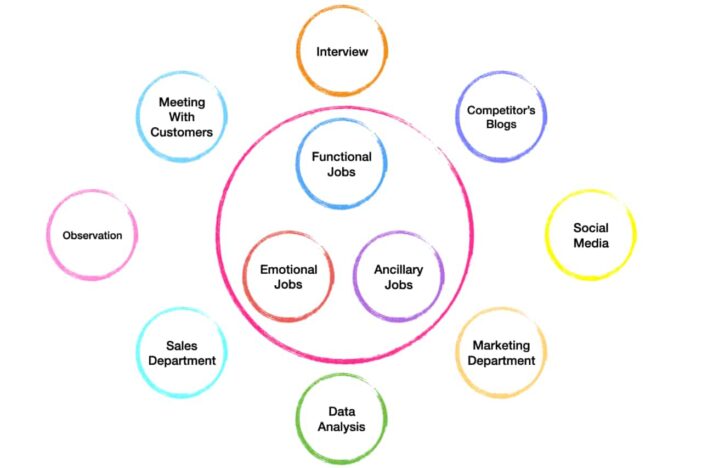
Functional Jobs
Functional jobs describe the tasks that particular customers want to achieve. These jobs are the basis for all products and services because they are their primary function of why they exist on the market. But, often they are not the most important jobs. In my experience, many entrepreneurs focus only on this type of job. They forget the next two types of jobs that often can be more important from the customer’s viewpoint.
Emotional jobs
Emotional jobs are related to feelings and perception. So, they are subjective. Emotional jobs can have different forms. For example, how they want to be perceived by others as a social job or how they want to feel about themselves as a personal job.
Ancillary jobs
Ancillary jobs are other jobs that customers want to do before, during, or after their primary job. So, these jobs are anything else as an addition to functional and emotional jobs.

Example for marketing consulting services
For example, if your company sells marketing consulting services, your customers don’t buy your marketing services. They are hiring solutions to increase their own customer base. So, they want more customers, and they need to do the job. Here the service must enable bringing more customers into the sales funnel. This is a functional job.
Example for clothing business
For customers who buy clothes from luxury brands, the functional job is the same as other cheaper clothing products. But, the emotional dimension is something that drives these customers to buy these products. So, in this example, the functional job is not something important as the emotional and social dimensions.
Example for mobile app
Another example is the company that sells a mobile app for invoicing on a mobile platform. They charge monthly usage fees. In this case, the company doesn’t sell the invoicing app. It sells services for creating and sending invoices without a computer for mobile entrepreneurs or salespeople. So, customers here are buying services that this mobile app will help them to do the job.
Innovation and creativity are not the same things. However, you can’t have innovation without creativity. Also, creativity will not be valuable if you are not using it properly in the innovation process. This video is a great TEDTalk presentation from George Land who talks about the failure of success. I highly recommend you to watch this presentation. Probably we need to think much more about what happened with our kids who lose their creativity as they grow.
Steps you need to take for implementation of “Jobs to Be Done.”
1. Select Your Target Market
As a first step using this tool, you will need to select and describe the target market that will define a job that will need to be done.
Startups can start with something close to an entrepreneur’s competence (knowledge, experience, and skills). On the other side, existing companies will need to think about the next incremental growth of their current market. For example, if your business sells computers, think about the software and apps market. If your company currently sells marketing services, you can think about expanding them. Include, for example, sales improvement services. So, you will need to expand close to your current market. In such a way, you will quickly use your current customer base to discover different jobs.
Also, you can think about your current products and services in the current market to bring innovation to them.
2. Identify Jobs Customers Are Trying to Get Done
In this step, you will need to analyze potential customers to find what they are trying to do related to the selected target market. Your job is to find a niche where doesn’t exist solutions yet. What jobs have no existing solutions, or they are not so good for the customers? If you discover jobs required for more than ten customers, you will know that you are on the right way.
Here is something that you will need to do to complete this step required by the tool “Jobs to Be Done.”
Observation.
When you know your target market and customers, you need to analyze them to gain as much as possible insights about them. This is important because you want to meet their needs in the future with your innovative products and services. There are also other things you can do, but I need to emphasize the importance of observation. In my experience, the results of observation from one side and interviews, meetings, and questionnaires, on the other hand, are different. Often they are conflicting. Why? Simply, because customers often don’t want to talk about or answer your questions with total honesty. But, if they don’t know that you are observing them while they are trying to do the job, they will act in reality, and these are the true insights for you.
Social media, forums, and blogs.
These tools are the potential source of information for you when it comes to your customers and the job they are trying to do. Find where they are going to these websites? What are they doing there? What information they are sharing related to their problems, frustrations, needs, and possible solutions.
Interview and meetings.
When you collect enough information from previous tools, start using interviews and meetings with your customers. Check the relevancy of already gathered information. Also, you can put in place focus groups with selected current and potential customers to collect extra information.
Marketing and sales department.
Your marketing and sales departments have the most information from first hand about your clients. They already talk to them. They already know why they buy your products and services or why they decline to buy your products and services. So, speak with the representatives from these departments to better visualize jobs your customers are trying to do.
Analyze your internal databases.
You already have your internal databases. There you can see complaints of your current customers, or frequency, recency, and the amount of money they spend in your company. All this information you can use to look for insights related to your customers and the job they are trying to do with your products and services.
When it comes to the observation, you will need to:
- Watch people in different situations who are trying to do a job and gain insights about what jobs they are want to do;
- Observe processes, companies, technologies used by people to do a job to find the possible better solutions that you can apply later.
10 Questions while observing customers
Jeff Dyer, Hal Gregersen, and Clayton M. Christensen in their book “The Innovator’s DNA – Mastering the Five Skills of Disruptive Innovators” propose ten questions to ask while observing customers:
- How do customers become aware of a need for your product or service? Is there a way to make it easier or more convenient for them to find your offering?
- For what customers use your product or service? What job is the customer hiring your product or service to do?
- What does the customer ultimately consider as the most important features when selecting a final product or service? (If the customer has a hundred points to allocate all the features he considers important, how would he allocate them?)
- How do consumers order and purchase your product? Is there a way you can make it easier, more convenient, or less costly?
- How do you deliver your product or service? Can you do it faster, cheaper, in a completely different way?
- How do customers pay for your product or service? Is there a way to make it easier or more convenient?
- What frustration do your customers have when trying to use your product? Do they use your product in a way you didn’t expect?
- What do consumers need help with when they use the product?
- Do customers do things that hurt the longevity or reliability of your product or service?
- How do customers repair, service, or dispose of your product? Are there opportunities to make this easier or more convenient (or teach the customer how to use the product, so it requires less maintenance or to do self-maintenance)?
3. List of Jobs to Be Done
The output from the previous step will be the list of possible jobs. Think about two situations when you create a list of jobs:
- Current solutions – What are the current solutions that customers use to get the job done?
- New solutions – What can be improved or innovated as a possible new solution that will be better than the current solution?
You have access to all tools, and forms required to do tasks related to this tool that can be downloaded at the end of this article.
4. Categorize the Jobs to Be Done
In this step, you will need to categorize jobs to be done already discovered with previous steps. In the list, you will probably have primary jobs and some related jobs to the main jobs. For example, if a person wants to manage their finance more easily, the related job can be easy accessed to the application from all devices.
There is no standardized way of categorizing jobs to be done. Different industries and markets will have different needs when it comes to categorizing. Think about the possible scheme that makes sense for you and your industry. If you can’t make categorization of discovered jobs, use functional, emotional, and ancillary jobs.
So, try to find a relationship between already discovered jobs and categorize them in no more than five categories.
5. Prioritize Jobs to Be Done
Sometimes there are hundreds of jobs that customers are trying to get done in a particular industry or market. So, now that you have a list and categories of jobs to be done, the question is which one will need to be the priority for you. Which ones provide the biggest opportunities for you?
You can prioritize the jobs using the importance-satisfaction matrix that will focus on:
- Importance of the job – How much importance customers place on a specific job to be done?
- Satisfaction with the current solution – How many customers are satisfied with the current solution?
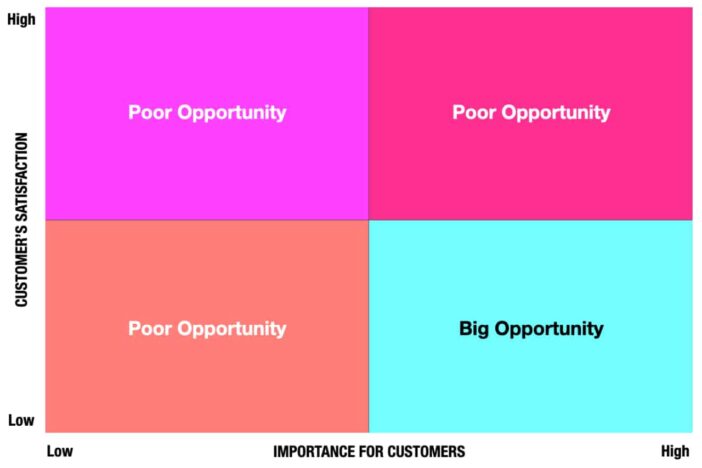
First Quadrant – Poor Opportunity
The first quadrant of the matrix is where the importance and satisfaction are low. Even though there are some possible opportunities, these jobs aren’t something that you need to focus on because of a low level of importance. Because of that, this quadrant is classified as a poor opportunity.
Second Quadrant – Big Opportunity
The second quadrant of the matrix is where importance is high, and satisfaction is low. This quadrant is a big opportunity for you. These customers see identified jobs as important for them, and at the same time, the current solution isn’t satisfactory. So, here is the place for a big win for you. These jobs need to be a priority for you.
Third Quadrant – Poor Opportunity
The third quadrant of the matrix has a high level of importance and satisfaction. Although there is great importance, customers are still satisfied with the current solutions. So, they will probably not need or be thirsty for new solutions. These jobs can be the second priority for you.
Fourth Quadrant – Poor Opportunity
The fourth quadrant of the matrix is of low importance and a high level of satisfaction. These jobs can generate poor opportunities for you. So you need to escape them for future consideration.
Jobs to Get Done Toolkit
Download the Toolkit