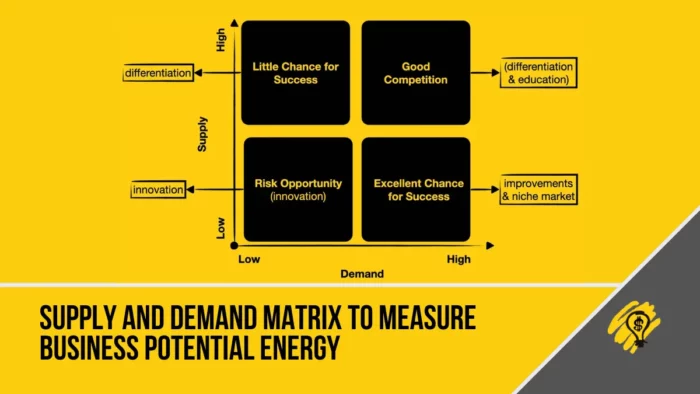

What will be the supply and demand of the specific products or services that will result from your business idea? To answer this question, you can use the supply and demand matrix.
Let’s look at what this simple tool is and how you can construct and use a supply and demand matrix for your business strategies.
📖 Key takeaways
- Most businesses don’t know the true value of their products or services in the market, so they miss opportunities or waste resources on low-demand or high-competition products.
- Without understanding supply and demand dynamics, you can enter saturated markets or miss out on untapped opportunities, resulting in financial losses and reduced market share.
- The supply and demand matrix is a strategic tool for evaluating market potential by examining the balance of supply and demand. By plotting your products or services on this matrix, you can make informed decisions, optimize your offerings, and develop targeted strategies for success in the market.
What is the Supply and Demand Matrix
I have developed the supply and demand matrix for more than ten years. My biggest goal then was to have a tool that would enable me to measure the business potential energy of brainstormed business ideas.
It’s a simple matrix that compares business ideas, offerings, or whatever you want to sell on a specific market through two dimensions of the market itself: supply and demand.
If there is a higher level of supply, that means there will be a higher level of competition in the market, and your future business will be at higher risk. This is contrary to the businesses that result from the business idea that products and services will have a lower level of supply and competition.
Logically, the competition will bring additional risk to your small business. So, when you start developing your business idea, you must include these considerations.
The same is true when it comes to the market’s demand, which will present the market’s needs. Thus, if the market demand is higher, the risk will be lower.
The supply and demand matrix is given below, which you can use when you want to consider these elements related to your business idea. The supply and demand matrix is not only for “would-be” entrepreneurs or startups, it can be used also when you want to expand to other markets because it will help your marketing and sales teams to prepare better offer adjusted for the customer needs on a specific market.
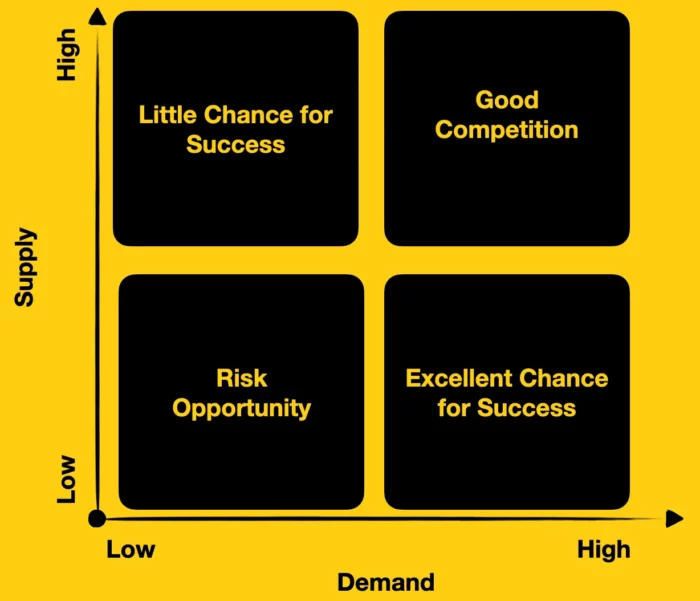
The Quadrants of Supply and Demand Matrix Explained
Quadrant 1: Little Chance for Success
If you have a large supply of specific products and services that, according to your business idea, you want to sell and a small demand for them on the market, you will have little chance for success. You must change or improve your business idea and remove such products or services. But, if you want to have them in your offer, you must create an appropriate differentiation strategy to attract customers’ attention to these products.
Quadrant 2: Risky Opportunity
The quadrant of the matrix with small demand and small supply I call a risky opportunity. How is it possible to have a risky opportunity on the other side? This market can become an excellent opportunity, but only if you increase the demand for products and services.
If you decide to enter such a market like this quadrant, with such products, your job as an entrepreneur will be to work on increasing the demand. If you feel you can do this, these products can be a great opportunity for your business. In most cases, these products are innovative products, and potential customers don’t even know they really need such solutions. Because of that, you will need to work on creating a customer’s need to increase the demand.
Quadrant 3: Good Competition
I call the quadrant with the higher demand and large supply good competition. This quadrant indicates that the products are in huge quantities on the market, and their consumption is huge. So there is good competition. You can choose your business idea based on these products, but you should know you’ll have strong competition. However, the risk is much lower because of the high demand.
Quadrant 4: Excellent Chance for Success
The quadrant is marked as an excellent chance for success and has the products or services for which there is high demand while supply is lower. You should include these products without thinking about your business idea. In most cases, it is not an easy job to find and recognize such a market opportunity. But, if you understand your target audience and their needs well, you can identify these opportunities.
Market research is one way to determine which products or services are in high demand. Another approach is to look at current market gaps or problems that have yet to be solved. If there is a lack of competition in addressing a certain need or issue, it could be a great opportunity for your business idea. This could also mean improving an existing product or service to stand out from the competition.
How to Construct the Matrix
1. Identify Market Demand with Intent Data
The first step to creating a successful supply and demand matrix is identifying the market demand for various products or services. Utilizing intent data, you can determine what customers are actively searching for or interested in purchasing. This will give you valuable insights into which products have high demand and potential for success.
Intent data are the actions and behaviors of customers that show their interest in a particular product or service. This includes keywords searched, website clicks, or social media interactions. By analyzing this data, you can identify trends and patterns to understand what products or services are in higher and lower demand.
One important thing at this step is to collect all intent data, put them in a spreadsheet, and, for each trend, ask yourself why. The “why” question will help you go deeper with your analysis and better understand the right customer needs that impact high or lower demand.
Why is this important?
Many times, when I have implemented the matrix at my clients’ businesses, I have seen one pattern that I didn’t like. For example, when entrepreneurs find that there is lower demand, they simply remove that option from the analysis. However, when you ask the “why” question several times, you will see some uncovered market opportunities that can be the foundation for innovation.
For example, if the lower demand is due to a lack of awareness or education about the product or service, this provides an opportunity to create educational content and improve marketing efforts. If the lower demand is due to a saturated market, this could be an opportunity to differentiate and stand out from competitors.
2. Research Supply Levels
Once you have identified the high-demand products from your intent data analysis, it’s time to research their supply levels. This includes understanding how many competitors already offer similar products, their pricing strategies, and any potential market entry barriers.
It’s important to thoroughly research the supply levels as this will help you determine if there is a gap in the market that your business can fill. If there is already an oversupply of a certain product, it may not be the best investment for your sales and marketing efforts.
Still, you must ask the question “why” several times because you don’t want to miss out on possible opportunities solely because of competition.
3. Plot on Matrix
Plot the products or services on the matrix using the information gathered from steps 1 and 2. This will give you a visual representation of where your products or services will stand in terms of supply and demand and how they compare to your competitors.
The matrix can help you identify any potential gaps in the market that you can exploit and areas where there may be an oversupply and, therefore, lower potential for success.
Remember, constantly monitoring and analyzing the market is crucial for your business success.
Intent data is key to identifying market demand and understanding target customers. Using customer intent data can improve your marketing strategies and increase sales.
4. Analyze and Balance Between Supply and Demand
Now is the most important part, where you must develop strategies or include the results from this analysis inside your business strategy, especially marketing and sales strategy. A thorough supply and demand analysis can help you determine the right approach for your business to thrive in the market.
When analyzing supply, consider availability, cost, and competition factors. Are there enough suppliers to meet the demand? Is the cost reasonable for both you and your customers? What are your competitors offering in terms of supply?
On the other hand, when analyzing demand, consider factors such as current trends, customer needs and preferences, and potential growth opportunities. Are there any emerging trends that could affect demand? What do customers want or need from your product or service? Can you tap into new markets to increase demand?
Balancing between supply and demand is crucial for maintaining a sustainable business. If there is an oversupply in the market, it can lead to price wars and a decrease in profits. On the other hand, if there is an undersupply, you may miss out on potential sales and lose customers to competitors.
In addition to external factors such as competition and trends, internal factors such as production capabilities and distribution channels also play a role in determining supply. It’s essential to have efficient processes to ensure a steady supply of your product or service.
How to Implement Supply and Demand Matrix in Business Strategy

The supply and demand matrix can be implemented in various business strategies, including marketing, sales, and operation.
For example, if there is a low demand and low offer (risk opportunity quadrant in the matrix), you can use strategies such as innovation, education, promotions, and discounts to increase demand and move towards the high demand and low offer quadrant. On the other hand, if there is a high demand and low supply (excellent chance to success quadrant), you can focus on improving production capabilities and simplifying distribution channels to meet the high demand or find the niche market with innovative niche products.
The most important strategy is differentiation when there is little chance of success and good competition quadrants. Our article on differentiation strategy explains the different types of differentiation elements.
Additionally, understanding the supply and demand matrix can help businesses anticipate potential shifts in their market. For example, if there is a sudden surge in demand for your product or service, but your supply is limited, you can quickly identify this as an opportunity to ramp up production and meet the rising demand.
Using it, you can identify areas of opportunity and optimize your business resources accordingly. The supply and demand matrix is particularly useful for businesses with complex sales cycles, b2b marketing and sales, and multiple stakeholders.
How to Overcome Common Challenges
Data quality and accuracy are common challenges businesses face when implementing the supply and demand matrix. To overcome this challenge, you must collect accurate market data related to supply and demand. You can use different information resources to conduct market research.
Another common challenge is integrating the matrix into existing business strategies and operations. To overcome this challenge, businesses can work with experienced consultants and implement a phased rollout approach.