How to Measure Business Plan Implementation Results in Your Company?

Measure Business Plan Execution

The business plan is a live document that serves to help you run your business towards achieving your business goal. It is not something to stay in the drawer and gather dust on it. You must ensure you are measuring success of execution. Because of that, you need to measure business plan implementation results and adjust your plan from time to time to adapt to new challenges.

It is not something that you need to set and forget. It is not something that you need to set and forget. You must remember that the business world is a world that is constantly changing. Effective decision makers play a crucial role in adapting and aligning strategies to ensure all stakeholders are on the same page.

📖 Key takeaways

  • Regularly measuring and comparing business plan execution results against planned goals helps identify gaps and enables timely adjustments to improve overall business performance. Performance measures are essential for identifying these gaps and making necessary adjustments.
  • Key elements to analyze include business goals achievement, products/services, market conditions, industry trends, marketing and sales performance, organizational structure, and financial metrics like profit and cash flow.
  • An effective measurement process involves controlling, comparing, identifying causes of deviations, and solving problems promptly to ensure successful strategy execution and continuous business growth.

Introduction to Strategic Planning

Strategic planning is a crucial process for businesses, as it enables them to define their goals, objectives, and strategies for achieving success. The strategic planning process involves analyzing the company’s internal and external environment, identifying strengths, weaknesses, opportunities, and threats, and developing a clear roadmap for achieving strategic objectives.

Effective strategic planning is essential for successful strategy execution, as it provides a solid foundation for making informed decisions and allocating resources.

However, many organizations struggle with the strategy execution gap, where the plan is not effectively implemented, resulting in a failure to achieve desired outcomes. By understanding the importance of strategic planning and its role in achieving business success, companies can develop a comprehensive approach to strategy execution that drives results.

Why You Need to Measure Business Plan Execution?

Business leaders are people who are always full of business ideas. The ideas are something that pushes forward all businesses. You, as an entrepreneur, may not have those ideas at a time when you have prepared your business plan. If you know that those ideas will increase your business success, you need to incorporate those business ideas into your business plan.

You can’t expect your strategic plan to be 100% accurate because it is based on historical data, analysis, and forecasts for the future. There will always be some level of strategy execution gap, making the task of executing strategic plans often feel like an impossible task.

Mistakes will be something normal either in the strategic planning process or execution, and that is reasonable. But mistakes, because you are not measuring the implementation of your business plan, are not reasonable and can bring catastrophic effects on your business. Because of that, you must compare what you have planned with the real numbers. Also, you must find the differences and causes of those differences.

In such a way, you can implement changes on the go as you start implementing your business plan, and it will improve your planning process. Utilizing real-time data will empower you to make timely adjustments, facilitating effective pivots and supporting a structured approach in strategy management. So, you will learn to implement many improvements in the next planning cycles.

If you succeed in implementing the pieces of advice I will give you here, you will not only implement improvements in the current and next planning processes, but also improvements in your whole business processes.

Elements You Need to Analyze and Compare When You Measure Business Plan Execution Results

What are the most important elements that you need to analyze and compare when you measure business plan implementation results?

Before we start with the measurement elements of your business plan, be sure that you have an operational planning process in your company. Follow this ultimate guide for building a basic business plan template. Also, you can use these 30 steps that will help you in writing your business plan and following your business plan mindmap.

Identifying friction points in the execution process is crucial. These obstacles or barriers can hinder the effective implementation of plans and processes, so addressing them is essential for smooth execution of strategic goals.

Organizational leaders play a vital role in ensuring effective execution. They may create well-thought-out strategies but often struggle with implementation due to various factors. Leadership training and the sharing of experiences among leaders are important to overcome these challenges and achieve success.

Here, I will cover some basic points of comparison that you need to use when you measure business plan implementation results:
11 elements measure business plan implementation results

1. Your Business Goals Achievement Results

Your business plan starts with your business goals. You must ask yourself and give answers to several questions. Have I accomplished the business goals that I set for the previous year? Will my current work enable me to achieve those goals?

This is important because if your goals are not achieved, you must change something in your current work. Aligning your strategies with the company’s goals is crucial for measuring success and adjusting strategies effectively. So, if this is the case, you will need to discover what the best things you need to do are in order to achieve the goals.

Sometimes, you may find that you are not in a situation to do something more. In such a case, the best possible thing you can do is to change your goals to become more achievable. Use SMART goals when you try to change goals in your business plan.

Remember that you set up your goals with the purpose of achieving them. Use this guide to set up your business goals, and then use this 7-step framework to achieve all your business goals.

2. Your Products/services

Different Types of Value

Have you introduced new products or services that you don’t have listed in your business plan? What are the results from comparing your products or services with those of your competitors? Do you have plans to introduce new products or services that you haven’t noted in your business plan? The products or services part of your business plan is one of the most important elements of your plan. You must continually follow them.

Tracking the number of new customers is a critical metric in assessing business performance. Monitoring this figure can help you evaluate your strategies and determine if you are on course to meet specific goals related to customer acquisition regarding your product/service.

Don’t forget to always work on adding more value to your customers inside your products or services. Here is how you can add more value to your products and services.

3. The Market Where You Compete

Market Size - Target Market

Are there the same trends on the market as you have predicted in your business plan?  Most of your business decisions will rely on the market conditions. You must follow your market if you want to stay there, because if you don’t follow the changes in the market, the market will reject you.

Sometimes, customers will stop buying from you. Here are five things you can do when this happens.

To stay competitive, it’s crucial to move the needle forward by making meaningful progress in response to market changes.

You can also check our step-by-step guide for conducting RFM analysis to segment your customers properly and focus on tactics that will bring the best results of your strategic plan.

4. The Industry of Your Business.

Are there crucial changes in your industry that were not predicted in your business plan?

Every industry has particular characteristics. For example, the IT industry has characteristics of quick and big changes in a shorter time period. If you want to stay in the trend of your industry, you must observe all changes in your industry. The real challenge lies in not just identifying these changes but effectively adapting your strategy to address them.

If you want to analyze your industry properly, answer these 42 questions.

5. Your Marketing Strategy

Is there some change in your marketing strategy that is not covered by your plan? How are you setting up your prices, promotions, and distributions?

All of these elements are categories that can change over time. These elements have an influence on your sales, current processes, and management. Because of that, you must include these changes in your business plan and ensure they align with your company’s strategy.

Be sure to escape the following 11 reasons for marketing failure.

6. Your Sales Achievements

Are your sales numbers the same as you predicted in your business plan?

Your current sales numbers will impact your profitability, cash flow, type of marketing activities, employment, etc. This is an important element, and your business relies on it.

To achieve your strategic goals, it is crucial to align your sales activities with these objectives. Ensuring that everyone within the organization dedicates their efforts towards implementing these strategic goals will help maintain engagement and accountability. So, you need to measure and make proper changes according to the results of the measurement.

Related: Real-life Organizational Decision-Making Examples

7. Your Marketing Plan

Do you implement some marketing changes that will require some changes in your marketing plan? If you have such changes, update them in your business plan.

For example, a strategic business plan will identify a target market, narrow it down to a manageable size, and establish a strategy for acquiring those customers. You must track progress updates that will help you to timely adjust your strategic objectives for effective execution.

8. Your Organizational Structure

organizational design definition

Is your organizational structure the same as you have noted in your plan? Is the management team the same or not? What’s going on with the employment plans?

Organizational structure is something that, in large part, has a role in the execution phase of your strategic plan. It defines how your company structures its internal management and operations to achieve its strategic objectives.

Clearly defined roles for project managers are crucial in driving results and managing expectations. Effective communication about performance measurements and responsibilities ensures successful project execution.

These are important questions you should ask yourself as part of the measurement process of the implementation of your business plan.

Related: Organizational Design: A Comprehensive Framework for Success

9. Profit/Loss

Is your profit/loss statement the same as you have planned to be in your current business plan?

This is an important question for you because it will show whether you are moving in the right direction when it comes to your profitability. Without proper implementation, even well-designed strategies can fall short of achieving your profitability goals. Knowing this, you will be able to quickly solve many problems related to your profitability.

10. Your Cash Flow

net cash

Is your cash flow as you have planned to be? I’ve seen many businesses work with profits on paper but have a negative cash flow that brings them close to bankruptcy. Traditional methods of tracking cash flow, such as using spreadsheets, can be time-consuming and inefficient. Adopting specialized tools can help alleviate these challenges, ultimately saving time and reducing errors in tracking progress and reporting. So, follow this article (Guide to Understand and Manage Cash Flow) for strategies and action steps you can take to improve your cash flow.

11. SWOT

Are your strengths, weaknesses, opportunities, and threats the same as you note in your plan? Have these elements been thoughtfully developed and shared with your team throughout the process? Is there a change in their influence on your business?

Role of Organizational Alignment

Do you want your business plan to succeed in everything it tries to achieve? Probably yes. But the path to successful strategy execution has many different crossroads. And in most cases, some paths will require building proper organizational alignment before you achieve the desired success. Alignment is an important thing you need if you want your teams and departments to work towards the same goals.

Organizational alignment means creating a clear and shared understanding of what your company wants to achieve, and making sure all employees understand their role in getting there. This needs good communication, a solid plan, and proper tools to see how things are going. You can’t just hope everyone figures it out on their own!

Yes, if you want to overcome endless planning cycles and disconnected business tools, you will need to start with organizational alignment. Think about how much easier execution becomes when everyone is pulling in the same direction. You need to have confidence in your alignment strategy if you want your business plans to actually work and not just remain nice ideas on paper.

Common Challenges in Execution

Many industries and companies do not have an extensive maneuvering space when it comes to strategy execution, or they just use that stereotype to find an excuse because of their own inability to execute plans properly.

Why do execution plans fail?

To succeed in executing your strategy, whether it’s related to a new product or service, process, or business model, a critical characteristic that you will need to overcome is poor execution. Many organizations struggle with a lack of strategic clarity, bad communication, and not having enough resources.

It is clear that in a large number of companies, the execution phase is where things break down. However, that little effort needed to track progress and measure success is an excellent opportunity to provide a competitive advantage for you. Without proper execution tracking, you will fail to achieve strategic goals and objectives, and this can ultimately lead to business failure.

Because of that, when you find yourself in such a situation, with limited success in strategy execution, your focus should be directed to understanding these common challenges. There is indeed an unlimited number of problems that can derail your strategy. However, if you develop strategies to overcome them, including identifying risks, creating clear roadmaps, and providing updates to stakeholders, your company will just not remain at the same level as other market participants.

Best Practices for Execution

How can you increase your business strategy execution success? I will provide some recommendations that do not go into those that are common, but which can help you in this process:

  • Start by developing a clear and comprehensive plan
  • Then move to setting measurable objectives
  • Go outside traditional thinking and focus on tracking progress

This requires effective communication, a solid plan, and proper tools to measure success.

Don’t focus on standardized approaches because they give limited directions to your teams. You want to use goal setting, prioritizing tasks and resources, and eliminating non-essential activities that don’t contribute to your strategic objectives.

Your execution success will increase when you follow these best practices and overcome the challenges of business strategy and plan execution. Mixing key performance indicators to measure success, providing feedback and progress updates to stakeholders, and making adjustments as needed to stay on track can bring you a totally new level of strategic achievement.

The Process You Need to Use When You Measure Business Plan Execution Results

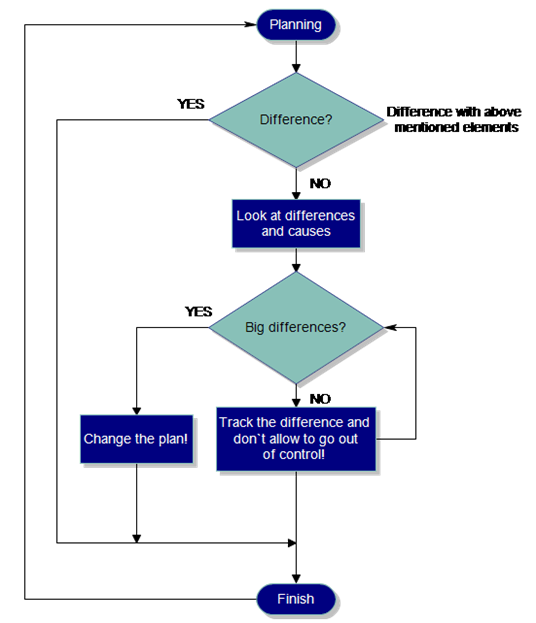
These are the basic activities that you must do in the process of measurement:

  • Control
  • Compare
  • Find causes for the differences
  • Solve all problems by eliminating negative differences.

A well-defined execution process is crucial in strategy execution as it allows organizations to respond swiftly to changes. It helps address common planning failures by aligning goals and metrics, fostering collaboration, and ensuring accountability across all levels of the organization.

The following picture is a flowchart for the activities you must perform when you measure business plan implementation results and compare different current business plan elements with the planned ones.

measuring business plan process