The design phase of a startup is the most challenging and important. It’s crucial to understand how to design a business model. Most businesses fail because they can’t create a proper model that will ensure the company makes money to survive first and then grow.
The most important thing about building a startup is understanding how to build a business model. To do this, you have to think about how your customers could use your product and how they will be affected by each option.
Before starting the development of a company, it’s vital to define how it will make money. The way you generate profit through a new product is defined by its business model.
📖 Key takeaways
- A business model gives an answer on how an organization creates, delivers, and captures value in economic, social, cultural, or other contexts. Or simply how the company makes money. On the other side, innovative business models can bring long-term competitive advantage.
- When you fill out your business model canvas (BMC), you’ll obtain a strategic view of all resources and processes and their interconnections required to produce and operate your business.
- The validated business model is a proven basis for mapping out the product development strategy and roadmap.
Understanding Business Models
The term business model and business model concept, in general, are not new concepts when it comes to businesses. There are so many scientific researches that I have seen covering complete or partial relationships to the success of the business. New business models, business model innovation, improvements, etc. All of these terms were always related to the success of each company.
Maybe in the past, it was not the case, but today, the primary function of a business model is to attract investment.
Your business model is something that can easily explain how your company creates, distributes, and communicates value with your customers in one picture. The value is the basic premise of each business. It is something that your company offers on the market.
What are Business Models?
The best approach to build a business model in a very descriptive way where you will obtain the most important aspects of your business is described throughout the book titled Business Model Generation – A Handbook for Visionaries, Game Changers, and Challengers from Alexander Osterwalder and Yves Pigneur.
In the book, they describe the business model concept and define a business model as:
rationale of how an organization creates, delivers and captures value.
Simply, a business model, in the end, is a representation of how an organization makes (or intends to make) money. So, a business model determines how an organization creates, delivers, and captures value in economic, social, cultural, or other contexts through the nine building blocks of the BMC.

You can create and have the values, but without proper distribution and communication of those values, you cannot expect to achieve business success. If you do not communicate values, your potential buyers will not know about their existence.
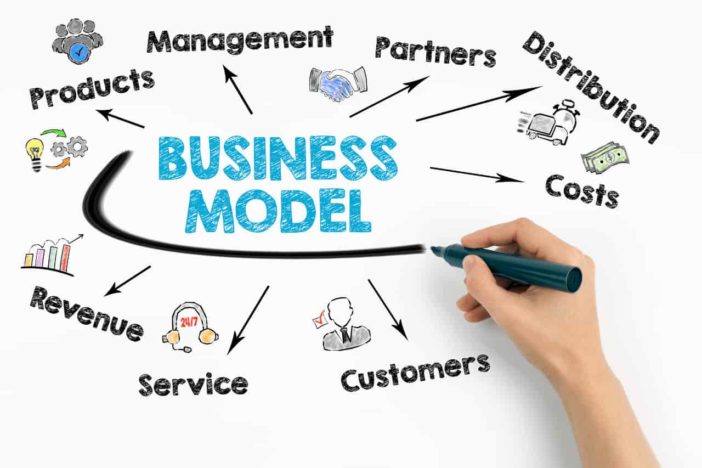
Business models can be simple pictures with diagrams that connect different business elements such as your values, distribution of that value, communication and distribution channels, customers, competitors, and stakeholders.
Remember, well-defined business models allow companies to differentiate their offerings from competitors.
Business Model Innovation
The term business model innovation means that you will adapt your existing business model to changing markets and technologies. An innovative and competitive business model can create new demand or meet unmet needs in the market.
For example, companies like Uber and Airbnb have revolutionized their respective industries through innovative business models. They have disrupted traditional taxi and hotel businesses by tapping into the sharing economy and using technology to connect consumers with providers.
But innovation doesn’t always mean completely reinventing a business model. It can also involve making small changes or improvements to an existing model that can lead to a big impact.
As a startup, your ability to create a new business model or modify an existing one can be the key to staying competitive. This process involves rethinking how your organization creates, delivers, and captures value. By doing so, you can increase your company’s resilience and potentially gain a significant competitive advantage.
The Strategic Importance of Business Model Innovation
According to Harvard Business School professor Clayton Christensen, business model innovation is a major priority for senior executives, but one of the reasons why they can not succeed is a lack of top management support and attention. This focus underscores its importance as a strategic tool for maintaining and improving competitiveness.
By adopting innovative business models, you position your startup to pass many challenges and capitalize on opportunities that traditional business models might overlook.
How to Innovate Your Business Model?
Developing an innovative business model requires a clear understanding of your market and a willingness to experiment with your business operations and processes. Start by analyzing your company’s business model and try to identify specific areas where changes could lead to improved performance.
Consider how you can implement new technologies, adapt to shifting consumer behaviors, or address unmet needs in your industry. For example, a successful pivot from traditional to subscription-based sales could create totally new streams of revenue for your business and increase customer loyalty.
One great article in the Harvard Business Review about how Chinese companies disrupt through business model innovation emphasizes that business model innovation is a key driver of competitiveness.
As a startup, you have the advantage of agility and the ability to test new ideas quickly. Use this to your benefit by iterating on your business model and learning from both successes and failures.
Business Model Components (Building Blocks)
The business model has nine essential elements that will explain the rationale of how a company creates, delivers, and captures value.
We will talk more about each component and the steps you need to take to design business models. Now, let’s look at nine elements:
- Value Proposition – the reason why customers choose one company over another.
- Customer Segments – the heart of any business model. You can group them into different segments with common needs, behaviors, or other attributes for better customer satisfaction.
- Customer Relationships – describes the relationships your business will establish with specific segments defined previously.
- Channels – mechanisms by which a company communicates with customers and delivers value to its segments. Companies can choose between reaching their customers through their own channels, partner channels, or a mix of both.
- Revenue – describes how the company generates cash from each customer segment previously defined.
- Partnerships – describes the network of suppliers and other established companies that make the business model work. Most companies depend on a strong network of suppliers and partners to accomplish more and with higher efficiency than they could achieve alone.
- Activities – describes the most important things a company must do to make its business model functional.
- Resources – describe the most important assets to make a business model work.
- Cost Structure – describes all costs incurred to operate a business model.
Here is a two-minute explanation video of the model that will help you systemize your efforts for your small business. Everything important for your company will be designed and included in this business. What is more important is that it will be a one-page sketch you will use to test and improve as you go.
Types of Business Models
Here’s a breakdown of some common business models to help you identify the best fit for your venture.
- Advertising models allow you to earn revenue by promoting products or services to your audience. This approach works well if you have a high-traffic platform, enabling you to monetize through ads.
- Affiliate business models, on the other hand, involve earning commissions by promoting other companies’ products, making it a low-risk way for you to generate income.
- A bundling model is when you combine multiple products or services together at a discounted rate, encouraging a single customer to buy more.
- Fee-for-service business models enable you to charge clients for each service generated, providing clear value and pricing.
- The franchise business model builds on an existing successful business and receives a percentage of earnings from franchisees.
- Freemium models let you offer basic services for free while charging for premium features, attracting a broad user base.
- Pay-as-you-go business models charge customers based on actual usage of a product and provide them with flexibility, allowing them to fulfill customer’s needs while they pay competitive prices at a sustainable cost – only for what they use.
- Marketplace models connect buyers and sellers, allowing you to earn commissions on transactions conducted through your platform.
- The subscription business model requires ongoing payment from customers, such as a recurring fee for access to products or services, providing a steady revenue stream.
- The manufacturer’s model sources raw materials to produce finished goods that are sold to retailers or customers.
- Retailer business models are for companies that sell directly to the end user, and those companies are the last entity in the supply chain.
By exploring these business models, you can tailor your approach to fit your unique vision and market landscape, setting your business up for long-term success.
Business Model Tools
There are many tools and resources available to help you design and innovate business models, including the business model canvas and lean canvas.
Business Model Canvas (BMC)
A business model is a strategic plan on how your product will deliver value to users in exchange for their money. To make the right decisions, you need to deeply understand the customer needs, your business’s value proposition, and the suitable structure of costs that will keep the product profitable over the long run.
A BMC designed by Alexander Osterwalder helps startups define all these aspects to get the desired business outcomes from the product.

The right part of the canvas describes the market and target customers. The left side focuses on the business’s internal factors, and the bottom part describes the values the product will deliver to users (value proposition).
Lean Canvas
Lean Canvas, designed by Ash Maurya, is another version of the BMC that focuses on lean startup principles. It has nine key elements: problem, solution, unique value proposition, unfair advantage, customer segments, channels, revenue, cost structure, and key metrics.
The first step in using either of these canvases is to understand the customer’s pain points or problems that your product aims to solve. By identifying this problem or need, you can determine the appropriate solution to provide. This will lead to your unique value proposition – what sets your product apart from competitors and makes it attractive to potential customers.
Another crucial aspect is having an unfair advantage over competitors. This could be a patent for a new technology or a highly skilled team with industry experience. This advantage will give your product an edge in the market and attract more customers.
Next, it’s important to define your target customer segments. Understanding their demographics, behaviors, and needs will help you tailor your product to meet their specific needs. These customer segments will also inform your marketing and sales strategies.
Once you have a clear understanding of your target audience, you can determine the best channels to reach them. This could include social media, email marketing, or partnerships with other businesses. By choosing the right channels, you can effectively reach and engage with potential customers.
Of course, revenue streams are essential for any business. You need to identify how your product will generate income – whether through sales or subscriptions – in order to sustain and grow your business.
While understanding your target audience and revenue model is crucial, it’s also important to continually analyze and adapt your strategies. This could involve tracking metrics such as website traffic, conversion rates, and customer feedback to make data-driven decisions.
Additionally, staying up-to-date with industry trends and innovations can help you stay ahead of competitors and continue to provide value for your customers. This may require attending conferences, networking events, or simply keeping a close eye on news and developments in your field.
How to Map a Company’s Business Model Using a BMC
Step 1: Outline your customer segments
Customers are at the heart of any business model. Without profitable customers, the company cannot survive in the long term.
A customer segment is a group of people with similar needs. You can reach them through the same channels, and you want to reach and serve specifically those customers. We can group them into different segments with common needs, behaviors, or other attributes for better customer satisfaction. You can define one or several different segments.
Think over the market type your future product is for. The major market types include:
- Mass market: No segmenting of the target audience. All customers have similar needs.
- Niche market: A product is for particular customer categories with distinct needs, values, etc.
- Segmented: A product is intended for two or more customer segments with different needs yet related problems.
- Diversified: A product is designed for two or more customer segments with distinct needs and concerns.
- Multi-sided markets: A product is aimed at interrelated customer segments.
Then, define your user categories and describe their behavior, needs, problems, and demographic characteristics. Group these details into each segment’s ideal customer profile (ICP). It would be great to develop a buyer persona for each ICP:

Step 2: Set value proposition
The value proposition is one of the most critical elements of the business model: it is the reason that customers choose one company over another. A list of features and benefits that can contribute to creating value for customers includes newness, performance, customization, design, brand, price, cost reduction, and risk reduction. It is why a customer may prefer your product over others.
Because these elements can significantly influence a customer’s buying decision, having the right mix of these elements will help ensure the company’s success in terms of revenue and profitability.
In a perfect scenario, it is a unique value a user cannot get with any alternative. It can be the benefits in performance, convenience, risk reduction, newness, price, status, etc. The value proposition should match your target customer profile to make the product deliver exactly what customers look for on the market.

Follow this step-by-step guide to build your superior value proposition to become number one on the market and stay in that position.
Step 3: Channels
Channels inside the business model will explain how your company communicates with customers and will deliver value to defined customer segments. Communication, distribution, and sales channels are part of the channels and how your company will communicate and deliver value.
The value proposition is delivered to customers through specific channels. These are also how customers find the solution on the market and start the sales cycle.
The channels can be:
- Direct: a company website or in-house sales channels
- Indirect: stores owned by the company
- Partner: sites, stores, and other selling points owned by other companies.
Partner channels require less investment yet imply paying a commission for sales, and you potentially lose a part of your profit. Direct channels bring higher margins but are more resource-consuming for arranging, operating, and managing.
Step 4: Map customer relationships
Customer relationship, as a part of the business model, describes the relationships your company will establish with specific customer segments you have defined previously.
The goals of customer relationships can cover the following:
- How will you get new customers?
- How will you increase the customer retention rate of current customers?
- How will you increase income through some types of up-selling and cross-selling?
Customer relationships fall into several categories: transactional, long-term relationship, personal assistance, dedicated personal assistance, self-service, automated services, communities, co-creation, etc.
Set how you will build relations with customers based on your customer segments’ expectations, goals, and preferences. Also, consider the product’s nature and your business goals. Here are some of the most popular types of relationships:
- Personal assistance
- Dedicated personal assistance
- Self-service
- Automated services
- Communities
- Co-creation
- Transactional relationships
Often, companies offer a range of options to choose from.
Step 5: Define your revenue model
This part of the business model describes how the company generates cash from each customer segment previously defined. According to Alexander Osterwalder and Yves Pigneur, revenue streams are the arteries if customers are the heart of a business model. You can generate different streams from each of your customer segments.
A business model can involve two different streams of revenue:
- Transaction revenues are from one-time customer payments, where customers come to the company to buy something and will never return or purchase anything again.
- Recurring revenues from ongoing payments for products and services that customers will pay in a specific time interval to use the product and service.
Follow this guide to build your revenue model using the answers to six important questions.
You can generate revenue in many ways based on what your customer types are willing to pay for and how they prefer to do it. For example, the typical revenue for digital products include:
- Usage fees
- Subscription fees
- Licensing
- Landing/leasing
- Asset sales
- Brokerage fees
- Advertising
Step 6: Set key resources
Resources are also crucial for the success of startup companies because they describe the most important resources that will ensure your business model works properly. Key resources for achieving success fall into four categories: physical, intellectual, human, and financial.
To run any business, you need specific resources. A business model cannot be realized without the necessary resources to create and deliver the value proposition, communicate with customers, earn revenue, and grow the company.
In product design, you need to plan resources to develop a product, launch and promote it on the market, maintain customer relationships, process orders, and generate revenue. Define and list all physical, intellectual, human, and financial resources to make your startup live.
Step 7: Define key activities in your business model
Key activities of the business model will explain the most important things your company will need to do to ensure that the business model is functional. A company’s operations or problem-solving activities are also essential to its success. Operations activities can include designing, manufacturing, and delivering. Problem-solving activities include knowledge management, continuous training, and maintaining platforms or networks.
Key activities describe the actions you need to run your business. These actions include
- Production: The product design, development, and delivery
- Problem-solving: The efforts to solve specific customer problems
- Platform/network: If you run as a platform, you’ll need steps to arrange its management, promotion, maintenance, etc.
Step 8: Identify key partnerships
The development of partnerships at the startup stage is an important success determinant for startup companies because this element of the business model will describe the network of partners that will be important for normal operations of the business model.
Most companies depend on strong partnership networks to achieve more and with higher efficiency than they could achieve alone.
If your business relies on suppliers and other partners, identify all these connections considering optimizing operations, reducing costs and risks, creating economies of scale, and providing all required supplies. List the following key partnerships:
- Non-competitor partnerships
- Collaboration with competitors
- Buyer-supplier relations
- Joint ventures.
Here is a step-by-step guide for building an innovation network that will allow your organization to be more effective in the long run.
Step 9: Set the cost structure
The cost structure describes all costs required to operate a business model and is another element that will define the potential for success of the startup company, as it directly impacts the profitability of a company and its growth potential. It includes all fixed and variable costs that form the product price and expenses for its production, maintenance, and distribution.
The type of cost structure that the business model will require is an essential determinant in reaching success.
Your startup may have a value-driven or a cost-driven cost structure. The first one focuses on maximizing the product’s value even if it implies a higher product price. The second one focuses on minimizing product costs.
Evaluating Successful Business Models
One effective way to evaluate your company’s business model success is by examining your company’s gross profit. Gross profit provides a clear picture of your business’s potential financial health by showing the difference between revenue and the cost of goods sold.
In such a way, you can assess whether your pricing strategy and cost management are aligned with your revenue goals. If your gross profit is consistently increasing, your business model effectively captures value from your customers.
Also, successful business models are those that not only generate revenue but also create significant value for your customers. As you design your model, consider how your product or service meets the needs and desires of your target audience.
Business models are tools that will help you determine how your company will make money and sustain its profit streams over time. To ensure long-term success, you must develop strategies that adapt to changing market conditions and consumer preferences, which is essential.
Common Business Model Mistakes
As human beings, we often complicate things, and complicated business models can prevent potential investors and slow down your company’s growth.
You want your business model to clearly communicate all business activities and demonstrate how your company intends to make money. An overly complex model can confuse stakeholders and obscure the value proposition, leading to missed opportunities and stalled progress.
Another common mistake is failing to align your business model with your overall business strategy. Your business model should seamlessly integrate with your strategic goals, ensuring every component works towards a unified vision.
For example, if your strategy focuses on innovation, your business model should support this by allowing flexibility and adaptability. Ignoring this alignment can lead to misdirection and potential failure, as your business may struggle to meet its objectives.
The last common mistake is failing to innovate and adapt your business models to changing market conditions, which can result in stagnation. The business landscape is dynamic, and your model must evolve to remain competitive. For example, innovative information technologies lead to new ways of doing business. So, including these technologies inside your processes will require changes to your business model.
If you regularly evaluate your competition and incorporate innovative business models, you can avoid becoming obsolete and ensure sustained growth. Stay proactive in recognizing shifts in consumer behavior and technological advancements to maintain your competitive edge.
Business Models Checklist
For several years, for the purpose of one of my clients, I have developed a checklist with 26 questions to check if you design your business models with all important components, ensuring you will not make the mistakes we covered above. You can download the checklist here.

Business Model as an Improvement Tool
The business model is one of the most important business elements around which everything else will be built. A simple but important part of entrepreneurial tasks is to develop the business model of their businesses.
It is something that can easily in one picture explain how a business creates value and distributes and communicates that value with its customers.
This week, I spent my time with a client to redesign the business model of their business. In this process, we used a BMC.
Here, I want to share some of our findings in this process:
- There is a possibility of seven more value propositions that can be implemented in the new model.
- We have brainstormed one additional channel.
- We find four additional customer segments that can be satisfied with the new model.
- We find one additional key activity.
- We find one additional key partner.
- We find even five additional possible income streams.
Today, the business is orienting toward a transactional relationship, which means when customers buy something, they have gone from the business point of view for the next purchases. In the new model, we look forward to finding additional income streams that will be more on a recurring basis.
If, in the next period of time, the entrepreneur succeeds in the implementation of the new model, he can build much stronger relationships with his customers and much stronger revenue streams that will guarantee future business wealth.
Because of that, I always approach the process of business improvement and organizational changes through the design and redesign of the basic business model. On the other hand, it is something that can present all sources of organizational change to me in a clear way. When I know the sources of organizational change, the whole change process is much easier.
Think about your business, answer as much as you can questions that draw the possible models and you can find endless possibilities of business improvements.