
Life is full of big decisions, and what you choose to do with your professional life is definitely among the biggest. After all, your profession of choice is so much more than just how you’ll be keeping the bills paid over the years. A person’s career path eventually becomes a huge part of their identity and personal sense of self as well.
Carefully considering the following factors when weighing your career path options can help ensure a decision you’ll be happy with for many years to come through effective career planning. Additionally, understanding the dynamic nature of career pathing can help you develop a diverse skill set that aligns with evolving career goals and market demands.
📖 Key takeaways
- A career path is key to your career growth. It guides you through your career and helps you achieve your long-term career goals by setting goals and making decisions.
- Career paths can be personal (your own) or organizational (company’s plan for career progression), with options for vertical or horizontal career paths. A horizontal career path allows you to try out different career paths and adapt to industry trends and job market demands.
- Overcoming career obstacles like lack of experience, competition, and industry changes requires continuous learning, skill development, and leveraging networking opportunities to stay relevant and achieve career goals.
Understanding Career Paths
Let’s first start with terminology related to understanding career paths, defining them, and discussing some types of career paths.
What is a Career Path?
A career path is essentially the roadmap of your professional life through a structured progression plan you can follow in your professional journey. Simply, it’s a series of jobs or positions that you progress through as you advance in your career.
Think of your career path as your own journey you take from your first job to your dream job, with each role preparing you for the next step.
So, having a clear career path is crucial because it helps you set goals, stay motivated, and make informed decisions about your professional development.
Types of Career Paths
Career paths can be broadly categorized into personal and organizational paths.
A personal career path is one you create for yourself based on your unique skills, interests, hobbies, values, and passions. It’s a highly individualized journey that reflects your personal aspirations and goals.
For example, if you have a passion for writing, your personal career path may lead you to pursue a freelance writing career or work as a content creator for a marketing company. If you have programming skills, you can work for an IT company.
On the other hand, an organizational career path is typically mapped out with the help of a direct manager or mentor within a company. This path focuses on moving through the organizational hierarchy within the organization, aiming for promotions and increased responsibilities over time.
An example of an organizational career path can be seen in the corporate world, where employees start as entry-level workers and move up on the organizational hierarchy to become managers, directors, and eventually executives.
Both types of career paths have their own values and can lead to fulfilling professional lives.
Vertical and Horizontal Career Path
I have mentioned above about personal and organizational career paths based on the source of such a career plan, your own (personal) plan, and the company’s (organizational) plan. However, when we talk about organizational career paths, there can be two different career paths: vertical and horizontal career paths.
Let’s look at both of them:
Vertical Career Path
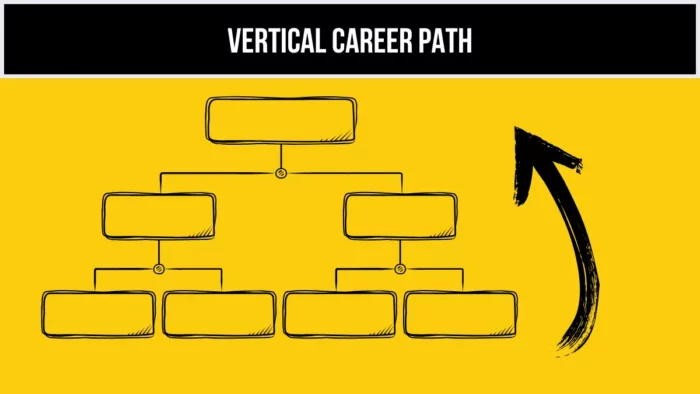
A vertical career path is when you move up the corporate ladder in your chosen field or department. This means promotions and more responsibility as you move through the organization.
For example, an entry-level marketing specialist may move up to senior marketing manager, then marketing director, and finally CMO. Each step on this vertical career path would come with more leadership opportunities, higher pay, and more influence in the company. But it will require more management skills.
Horizontal Career Path
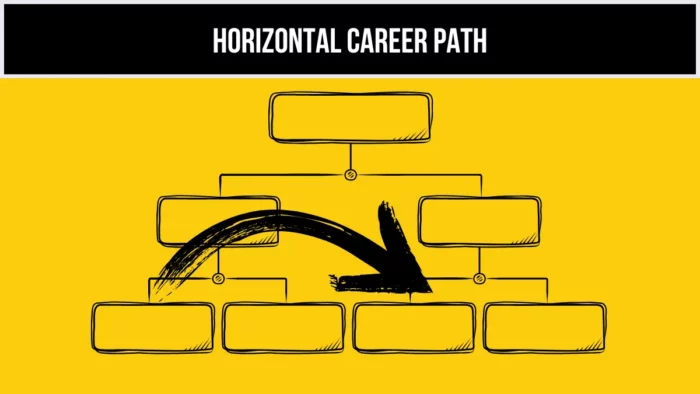
On the other hand, a horizontal career path is when you move laterally within an organization, often across different departments or functions. This type of movement allows you to gain experience in different areas of the company and develop broad skills.
For example, a marketing specialist may spend a few years in the marketing department before moving to the sales department. From there, they could move to the customer service team and then on to product development. This type of career path allows you to broaden your knowledge and skills while staying within the same company.
Career Path Stages
Career development is a lifetime journey with several stages. Knowing these stages will help you navigate your career better.
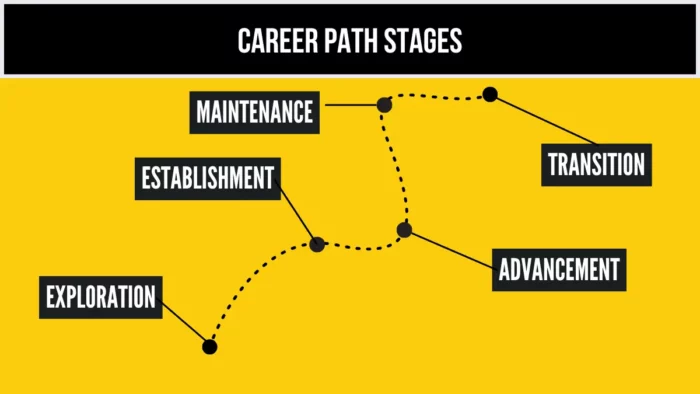
1. Exploration
This is the first stage, where you explore different career options and identify your strengths, weaknesses, interests, and values. It’s a time for self-discovery and research to figure out what career might be good for you.
2. Establishment
Establishment is the next stage where you start building yourself in your chosen career. You get your first big break, start building your network, and start establishing yourself in the industry. It’s where all your hard work pays off.
3. Advancement
As you gain experience, you move into the advancement stage. This is where you take on new challenges, go for promotion, and develop new skills to further your career. It’s a time of growth and more responsibility.
4. Maintenance
Once you’ve advanced in your career, the focus shifts to maintenance. This means continuing to develop new skills, staying updated with industry trends, and adapting to changes in the job market.
5. Transition
At some point, you may find yourself transitioning to a new career or industry. This could be by choice or due to external circumstances. It’s a time for reassessment and planning to make sure your new career path aligns with your evolving goals and interests.
What Will Impact on Your Career Path
Let’s look at the critical elements that can impact your career path.
1. Passions and Interests
A truly fulfilling profession doesn’t just pay you well for your efforts. It allows you the chance to do work you love in an environment that’s well-suited to your personality and working style.
Are you a people person who loves helping others, or are you an intellectual type who adores working with information, numbers, and ideas?
A job that lets you be around what (or who) you’re passionate about is a job you’ll stay excited about over the years and continue to love even when the going gets rough.
Using a career path quiz can help individuals define their career journey by aligning it with their personal values and interests. Read more about these quizzes here.
2. Knowledge and Skills Required
What is your knowledge? What skills do you possess? Or what your experience is in a specific field.
Your competencies, such as knowledge, skills, and experiences, will impact the different career paths you want to have. For example, having an academic degree and not having one, you will have different career paths.
Also, your previous experience in another or the same company will also impact how you advance in your career.
3. Marketable Skills for Career
While it’s definitely important to pick a field you know you’ll enjoy, it’s also prudent to leverage what you’re good at when making your choice and to consider different career paths.
If you’re amazing with money, a career path in banking, accounting, or stock brokerage might be a possible fit.
On the other hand, if you’re super creative and great at coming up with amazing ideas, advertising or web design could be your calling.
A potential professional skill could be literally anything you’re great at, though. Consider how your strengths could come in handy at a given job, or think back on compliments you’ve received from employers in the past for even more clues.
Related: 10 Reasons Being An Entrepreneur Is Better Than Employment
4. Desired Flexibility
Not everyone is able to commit to very rigid working hours or tons of overtime, while others simply may not want to. If that’s the case for you, research flexible careers that bless your life with meaningful work and solid pay while still allowing you the flexibility to raise your children, pursue productive hobbies, and more.
Great options to consider include but are not limited to massage therapy, law, or consulting. If you’re good with your hands, there’s also wonderful earning potential out there for electricians, HVAC installation specialists, contractors, and similar types of professionals.
In contrast to the traditional linear career path, which is becoming less common, modern career trends emphasize the importance of flexibility and exploring diverse roles and industries.
5. Job Market Availability for Your Career Path
Many people set their heart on a particular profession and even take steps to start training, only to find out that their options are slim when it comes to actually available positions.
Exploring different career paths can help you strategically assess your skills and experiences to identify potential directions for your career development. You could well wind up stuck at a job that doesn’t really fit you for years in hopes of eventually working your way up to where you want to be.
Choose a professional field where there’s plenty of existing and potential demand for skilled, dedicated workers. Healthcare and medicine are great examples, as are computing and technology.
If you’re desiring to get involved in the tech industry, you may find a tech job. If you’re a self-starter, you may also want to consider being your own boss and putting your existing skills to good use as a freelancer.
6. Industry Culture
The culture attached to a given industry is a factor that can greatly influence a given person’s job satisfaction, but many fail to consider it beforehand. After all, it’s really not enough for the work itself to sound amazing or offer lots of potential.
If the value system attached to the field you’ve chosen isn’t really a fit for you, you may still wind up feeling unhappy, frustrated, and unfulfilled. Look into what the people and typical working environments in your field of choice are really like. Did what you learn to paint a picture you can truly see yourself fitting into, especially when you factor your career goals and desired lifestyle into the equation?
How to Overcome Obstacles in Your Career Path?
Every career path comes with its own set of challenges. Here are some common obstacles you might face and how to overcome them:
1. Lack of Experience
If you’re new or switching fields, lack of experience can be a major hurdle. When I graduated, I searched job boards, and everywhere I looked, it required 3-5 years of experience. I asked myself, how can I get a job and build up my experience when I have just graduated?
However, I started to work for free in order to increase my experience, and this approach, after some period of time, brought me amazing opportunities.
You can overcome this by seeking internships, volunteer opportunities, or some entry-level positions that give you practical work experience. In my case, networking and building relationships in your desired field can also open up some doors to start building your experience and overcome this challenge.
2. Competition
We all know how highly competitive the job market can be. Each job has its own job responsibilities, and many people can compete for the same job.
If you want to stand out, you must focus on the right skill development and build up your experience to differentiate you from others.
Remember that investing time and money in continuous learning and professional development can always give you an edge over other candidates.
3. Self-Doubt and Fear of Failure
It’s natural to experience self-doubt and fear of failure, especially when facing new challenges in your desired career trajectory.
I always recommend my students to write on a piece of paper their long-term career objectives and, according to them, generate the most important competencies. With a clear personal career path and continuous learning for the development of confidence, you will overcome this challenge. When you feel competent and know how to do the job, your self-doubt and fear of failure will disappear.
Also, you can build your own confidence by seeking mentorship, building a support network of colleagues and friends, and focusing on small, achievable goals.
4. Industry Trends
Industries are constantly evolving, and if your desired career pathway is in a specific industry, you must stay relevant. I have seen that this can be really challenging for many people.
To succeed on your personal career path, you must ensure that you keep up with the latest developments in your field. You can attend workshops and training programs and be open to learning new skills. Also, there are tons of online courses you can use to stay updated with industry trends. Still, for this purpose, I always recommend giving priority to live events because then you can be seen and start building relationships with other people.
Also, you must ensure that you can easily adopt new technologies. This will help you stay more competitive and prepared for future opportunities.
Remember, to achieve your career goals, every challenge is an opportunity for growth and learning, and with the right mindset and strategies, you can overcome any obstacle on your career journey.
What You See As a Success in Career Planning?
Even though I cover success at the end of this article, this is still one of the most important parts when you define your career path and especially your own career goals.
Why?
Because of how you define success, such a plan you will create for your career development.
Success doesn’t necessarily look the same to everyone, so it’s important to figure out what it really means to you. Does it mean a big paycheck and the potential for early retirement, or is it more about doing meaningful work that truly touches lives? Someone will define career success in terms of work-life balance. Others will require more fulfilling jobs.
So, there’s no wrong answer to this question, but you’ll want to know yours before committing to a career path. Your personal definition of success may differ drastically from society’s typical approach, and that’s OK.
Ultimately, it’s up to each individual to define success for themselves and plan their life accordingly.