I want to invite you to explore a concept that might sound theoretical at first, but in my experience, it is the most practical lever you have for business growth: The Butterfly Effect.
As entrepreneurs, we are often addicted to the “big win.” We look for the “magic bullet”—that one huge marketing campaign, the viral product launch, or the massive partnership that changes everything overnight. We want the breakthrough.
But my practice shows that true Business Potential Energy isn’t built in giant, exhausting leaps. It isn’t built by swinging for the fences every time you step up to the plate. It is built in the microscopic, almost invisible changes we make every single day.
If you have ever felt like you are working harder than ever but your results feel like déjà vu—repeating the same profit cycles year after year—it is likely because you are ignoring the butterflies..
From Chaos Theory to Cash Flow

To understand how to fix this, we have to look outside of business for a moment. What exactly is the butterfly effect?
It comes from Chaos Theory. In the simplest words, it means that small things can have massive effects on the output of a complex system. If you do something today that goes unrecognized—something seemingly insignificant—it can bring about a completely different reality tomorrow.
The term was coined by Edward Lorenz, a mathematician and meteorologist in the 1960s. He was running a computer simulation for weather forecasting. One day, he decided to take a shortcut to save time. Instead of entering the full precision of a number from his previous data (which was .506127), he rounded it off to .506.
He assumed the difference—less than one part in a thousand—was too tiny to matter. It was just a rounding error, right?
He was wrong.
When he ran the simulation, he received entirely different results. The weather patterns completely shifted based on that tiny decimal change. The “weather” in his simulation didn’t just change slightly; it diverged into a completely different future.
He named this the butterfly effect to describe the phenomenon that if a butterfly flaps its wings in one place (like Brazil), it can disturb the air pressure just enough to eventually cause a tornado in another place (like Texas).
In business, you are the weather maker. And your daily habits are the butterflies.
The Two Trajectories: Growth vs. Decay
The butterfly effect is happening in your small business right now, whether you acknowledge it or not.
Your business is a complex system, just like the weather.
In the everyday activities of your operations, there are constant fluctuations. Small changes in one process can have a ripple effect on the whole business. However, for a small business owner, this effect splits into two distinct paths.
You are either spiraling up, or you are spiraling down. There is no neutral ground.
1. The Positive Butterfly Effect (The Spiral Up)
We are what we repeatedly do. Excellence, then, is not an act, but a habit.
Aristotle
The first way is obviously what we desire. The positive effects are the continuous improvements of your business processes.
These improvements do more than just fix a problem today; they increase your overall business potential energy.
Think of potential energy like a coiled spring or a battery. When you improve a process—for example, you automate your invoicing—you aren’t just saving five minutes.
You are storing energy. You are freeing up mental bandwidth and reducing friction.
That stored energy is now available to be deployed into sales, strategy, or innovation.
2. The Negative Butterfly Effect (The Spiral Down)
The second way is the silent killer of potential. With a negative butterfly effect, your business suffers from the compounding interest of bad habits.
Let’s look at a real-world example. Imagine a “negative butterfly” in the form of a messy digital filing system.
- Day 1: You save a file to the desktop instead of the correct folder because you are in a rush. (Small flap).
- Day 30: You spend 10 minutes looking for that file. You get frustrated. You send the email late.
- Day 60: The client receives the late email, feels undervalued, and decides not to renew their contract.
A $10,000 contract wasn’t lost because of a bad sales pitch. It was lost because of a file saved on a desktop two months ago. In such a case, you must escape or eliminate such a change immediately. If left unchecked, this effect will drain your business potential energy until the system collapses.
Your task is simple but difficult: Eliminate all negative butterfly effects and stimulate the positive ones.
The Mathematics of Momentum
This is not just philosophy; it is mathematics. Let’s look at a concrete example of how this works financially using the concept of compound growth.
Compound interest is the eighth wonder of the world. He who understands it, earns it… he who doesn’t… pays it.
Albert Einstein
Imagine you have a daily profit of $100 from your everyday business operations.
If things stay exactly the same (a stable state), after one month you will have $3,000.00 in profit. After one year, your profit will be $36,000.00.
But in business, things rarely stay the same. This is where the Butterfly Effect Factor comes in. This factor represents the rate at which your activities increase (improvement) or decrease (neglect) your results.
- Factor 1.00 (Stagnation): You have a profit of $100 every day. You are standing still.
- Factor 1.10 (Improvement): You improve your processes so that your profit grows by 10% periodically.
- Factor < 1.00 (Entropy): You allow inefficiencies to creep in, reducing your effectiveness.
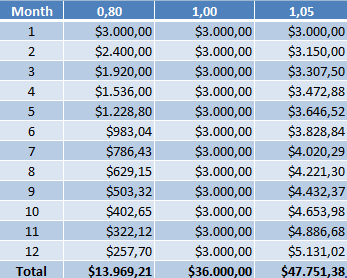
The table below shows the “Moment of Truth.” It compares a negative factor (0.8), a neutral factor (1.0), and a modest positive factor (1.05) over 12 months.
| Month | 0.8 | 1.0 | 1.05 |
|---|---|---|---|
| 1 | $3.000,00 | $3.000,00 | $3.000,00 |
| 2 | $2.400,00 | $3.000,00 | $3.150,00 |
| 3 | $1.920,00 | $3.000,00 | $3.307,50 |
| 4 | $1.536,00 | $3.000,00 | $3.472,88 |
| 5 | $1.228,80 | $3.000,00 | $3.646,52 |
| 6 | $983,04 | $3.000,00 | $3.828,84 |
| 7 | $786,43 | $3.000,00 | $4.020,29 |
| 8 | $629,15 | $3.000,00 | $4.221,30 |
| 9 | $503,32 | $3.000,00 | $4.432,37 |
| 10 | $402,65 | $3.000,00 | $4.653,98 |
| 11 | $322,12 | $3.000,00 | $4.886,68 |
| 12 | $257,70 | $3.000,00 | $5,131.02 |
| Total | $13.969,27 | $36.000,00 | $47.751,38 |

Look at the difference.
At a glance, the difference between 1.0 (Doing nothing) and 1.05 (Small improvements) doesn’t look like much in Month 2. It’s only $150. Most entrepreneurs would ignore that $150. They would say it’s not worth the effort.
But look at the totals.
With the negative butterfly effect, the annual profit crashes from $36,000 to roughly $14,000. That is a decrease of more than 60%.
But, with a positive effect—just a small 5% monthly improvement—the annual profit increases from $36,000 to over $47,000. That is an increase of more than 30%.
The gap between doing “okay” (1.0) and doing “slightly better” (1.05) is over $11,000 in pure profit. That is the power of the factor.
Mathematically, this is governed by the exponential growth formula:

Where r is that tiny daily improvement. If r is positive, you become unstoppable. If r is negative, you slowly bleed out.
How to Stimulate Positive Butterflies
So, how do you ensure you are on the right side of this equation? How do you become the architect of a positive storm?
To stimulate the positive effect in your business, you must stimulate improvements on all business levels. You cannot be the only butterfly flapping your wings. If you are the only one trying to improve things, you will eventually burn out.
You need to build a machine of continuous improvement. Here is how you do it effectively.
1. The “Idea Funnel”
You need to encourage each employee to generate improvement ideas.
Most employees see problems every day that you, as the owner, are blind to. They know which printer jams. They know which customer questions are repeated 10 times a day. Also, they know where the friction is.
Great things are done by a series of small things brought together.
Vincent Van Gogh
You need a culture where team members find themselves safe and motivated to suggest small tweaks that will bring continuous changes to your business processes.
Try this actionable step: Implement a “2-Second Lean” morning meeting. Ask your team: “What is one thing that bugged you yesterday, and how can we fix it today?”
2. Focus on Process, Not Just Output
We often focus on the goal (make $1000) rather than the process (how we sell). The Butterfly Effect lives in the process.
Look for small changes like:
- A faster way to invoice (saves 10 minutes/week).
- A cleaner way to organize inventory (reduces waste by 2%).
- A friendlier script for customer support (increases retention by 1%).
These changes, individually, seem small. But collectively, they are the butterflies that change the weather.
3. Implement the “Kaizen” Philosophy

Kaizen is a Japanese loanword meaning “change for the better” or “continuous improvement.” It is the philosophy that built Toyota. It relies on the belief that everything can be improved, even if it isn’t broken.
Don’t wait for a system to break before you fix it. Improve it when it is working well. This increases your Business Potential Energy so that when hard times come (and they will), your business is robust enough to handle the storm.
Conclusion: The First Flap
Continuous improvement is better than delayed perfection.
Mark Twain
Improvement is a process that must be the everyday task of all businesses. Without continuous improvement, there is no development. There is only decay.
The table we looked at earlier proves that standing still is a myth. You are either growing by 5% or shrinking by 20%.
So, I want you to stop looking for the magic bullet. Stop waiting for the “perfect time” to overhaul your business. Instead, look at your desk. Look at your inbox. Look at your team.
Find one small thing—one tiny, insignificant butterfly—and make it fly in the right direction.
Start flapping your wings today.