How to Achieve Exponential Business Improvement Using the Business Potential Energy Framework

Exponential Business Improvement

In the world of entrepreneurship, one thing that often leads to lasting success is making consistent business improvements. There is a reality that few talk about: the grind. We see the headlines about billion-dollar exits and overnight successes, but real entrepreneurs know the truth. Success isn’t a single event; it’s a process.

Entrepreneurs must continuously search for ways to improve their business. In fact, if you look at your calendar, these efforts related to business improvements likely make up around 90% of your daily activities. You aren’t launching a new company every day; you are tweaking, fixing, optimizing, and pushing the existing one forward.

However, business improvements and changes are constant. The market doesn’t stand still, and neither can you. If you are just fixing problems as they arise—playing “whack-a-mole” with operational issues—you are running in circles. You might be busy, but you aren’t growing.

Here, I want to introduce a process that changes that dynamic. It moves you from linear fixes to exponential growth using the business potential energy technique.

The Physics of Profit: Potential vs. Kinetic

The Potential vs Kinetic Diagram

To understand why some businesses stagnate despite working hard, we need to borrow a concept from physics. Let’s look at the relationship between Business Potential Energy and Business Kinetic Energy.

In physics, potential energy is stored energy waiting to be used. Think of a massive boulder sitting at the top of a hill. It isn’t moving, but it has a massive amount of energy stored within it simply because of its position and mass.

In your company, Business Potential Energy is the energy stored in your assets. It is your team’s skills, your intellectual property, your cash reserves, your brand reputation, and your market position. It is there, but it is currently sitting still.

The value of an idea lies in the using of it.

Thomas Edison

To get results, this must be transformed into Business Kinetic Energy.

Kinetic energy is the energy of motion. It is the boulder rolling down the hill. In business terms, it is the energy that performs business work. And let’s be clear about what “business work” means: it is the only thing that brings profitability to the company.

The Trap of “High Potential”

Many entrepreneurs fall in love with potential. They love building the “perfect” product, writing the “perfect” business plan, or hiring the “smartest” team. They stockpile potential energy.

But potential alone is worth zero.

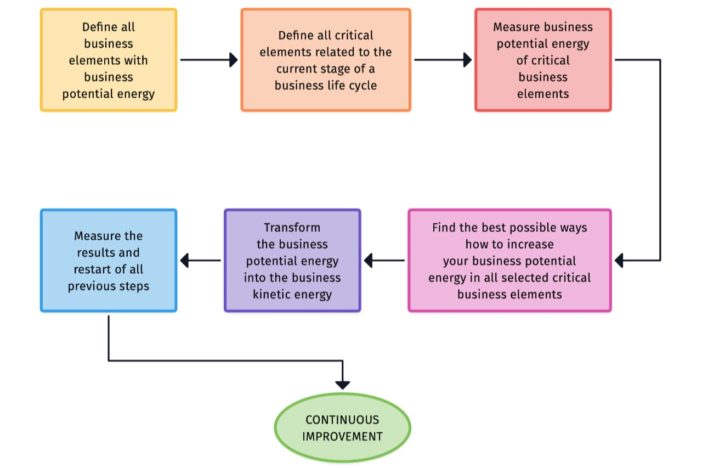
The methodology I am presenting here creates a spiral, never-ending process of business improvement. It ensures that you aren’t just hoarding potential, but constantly transforming it into profit.

With the right implementation, your business will not be the same from one day to the next—it will be stronger.

Business Potential Energy - Stages

Step 1: The Audit (Identify Critical Elements)

You cannot improve “everything” at once. That is a recipe for burnout. If you try to optimize your accounting software, your sales script, your warehouse layout, and your logo all in the same week, you will achieve nothing.

Your first task is to define the specific business elements that hold this potential energy.

Context is King: The Business Life Cycle

But here is the catch: context is everything. Because your business changes, you must define the exact stage of the business life cycle where your business is acting now.

A critical element for a startup is a distraction for a mature company, and vice versa.

  • The Startup Phase: Your potential energy is almost entirely locked in product development and market fit. If you spend your energy optimizing “Corporate HR Policies,” you are optimizing a non-critical element. That is wasted potential.
  • The Growth Phase: Your potential energy shifts to scalability and sales processes. You have the product; now you need the engine to deliver it.
  • The Maturity Phase: Your potential energy might be in your brand equity, customer loyalty, or distribution channels.

Your managerial skills are crucial here. You need the discernment to define which elements are truly critical for this specific stage.

The 80/20 of Energy

Deciding what not to do is as important as deciding what to do.

Steve Jobs

You want to focus your business improvement efforts on the most important things for the sake of efficiency. You don’t want to fracture your attention or lose time on elements where the improvements will be too small to notice.

Ask yourself: If I improve this element by 10%, will it double my output? Or will it just make me feel more organized?

We are looking for the levers that move the world, not just the furniture.

Step 2: Measurement (The Invisible Metrics)

If you can’t measure it, you can’t improve it.

Peter Drucker

Measurement, measurement, and measurement. This is the constant process in every successful business. You likely already measure your realization (revenue) and your activities (tasks).

But let me ask you a harder question: Are you measuring your energy?

Most entrepreneurs measure lagging indicators—things that have already happened (last month’s sales). To improve exponentially, you must measure leading indicators—the potential energy that predicts future success.

For all the critical business elements you identified in Step 1, you must now measure their Business Potential Energy.

How Do You Measure “Potential”?

This is where critical thinking comes into play. Since potential energy is “stored,” it’s harder to see than cash in the bank. You have to look for capacity.

  • Human Capital Potential: Don’t just count heads. Measure the skill gap. If your team needs to sell AI solutions but only understands basic software, their potential energy is low relative to the market demand.
  • Innovation Potential: How many ideas are in your pipeline? How many prototypes are ready to test? If the pipeline is empty, your future kinetic energy (sales) will drop to zero.
  • Customer Potential: What is your Net Promoter Score (NPS)? High customer satisfaction is stored energy that converts into referrals (kinetic energy) later.

As an entrepreneur, you must understand the numbers. By measuring potential, you increase your knowledge about:

  • The Level: How much energy is actually stored in your crucial elements?
  • The Hotspots: Which elements have the highest levels of potential (strengths)?
  • The Leaks: Which business elements are starting to lose their potential energy?
  • The Gap: What activities are required to recharge elements with poor potential?

Step 3: Optimization (Increasing the Charge)

The Energy Leak (The Audit)

Once you have your measurements, you will likely find “problematic business elements.” When I say problematic, I mean elements with poor potential energy.

Perhaps you realized in Step 2 that your sales team has high energy, but your fulfillment department has low energy (old technology, slow processes). This is a bottleneck.

The Theory of Constraints

In physics, a chain is only as strong as its weakest link. In business, your revenue is capped by your lowest-energy critical element.

Before you try to grow, you must fix these leaks.

If you pour marketing dollars (Kinetic Energy) into a business with poor fulfillment processes (Low Potential Energy), you aren’t growing—you are just annoying more customers faster.

By finding the best possible ways to increase the business potential energy in these specific, critical areas, you raise the “voltage” of your entire company. You might need to:

  • Train your staff (increasing skill potential).
  • Upgrade your tech stack (increasing efficiency potential).
  • Refine your marketing message (increasing conversion potential).

You are preparing the system for the next step: the release of energy.

Step 4: The Transformation (Potential Into Kinetic)

This is the most dangerous trap for entrepreneurs. This is where the rubber meets the road, and unfortunately, where many businesses slide off the track.

Many have the capability to increase the overall business potential energy of their company—they hire smart people, buy great tools, and build great plans. They have a massive boulder sitting at the top of the hill.

But they don’t know how to push it.

They don’t know how to transform that energy into kinetic energy.

Overcoming Inertia

Remember, kinetic energy is the energy that performs the work. It is the execution. It is the sale. Also, it is the shipping of the product. It is the invoice being paid.

Why is this transformation so hard? Friction.

Internal bureaucracy, fear of failure, perfectionism, and lack of clear delegation are all forms of friction that keep potential energy locked up.

A good plan violently executed now is better than a perfect plan next week.

General George S. Patton
  • The “Meeting” Trap: A meeting about a strategy is Potential. Making the sales call is Kinetic.
  • The “Planning” Trap: Writing a 50-page marketing plan is Potential. Launching the ad campaign is Kinetic.

If you don’t know how to transform your stored potential into something tangible, your previous work will be for nothing. A battery that never powers a device is useless.

Building the Transformation Engine

To solve this, you need “Activation Energy.” You need mechanisms that force the shift:

  1. Deadlines: Artificial pressure that forces potential to convert to kinetic.
  2. Minimum Viable Products (MVPs): Shipping something small today rather than something perfect next year.
  3. Sales-First Mentality: Prioritizing activities that touch the customer over activities that just touch internal documents.

You must build the mechanisms that convert your assets (Potential) into profitability (Kinetic).

Step 5: The Spiral (Measure and Restart)

This brings us to the final, and most important, part of the methodology: Feedback.

Feedback is a vital element for all systems. At the end of the process, you must measure the outputs. Did the kinetic energy result in the profitability you expected?

If you pushed the boulder (Kinetic) and it didn’t smash the target (Profit), you need to know why.

Was the boulder too small?

Did you push it in the wrong direction?

It’s Not a Circle, It’s a Spiral

But business improvement isn’t the end of the road. It is the start of a new lap.

Many people think of business cycles as a circle—you end up where you started. I want you to visualize a spiral.

When you measure the results, you restart the whole process, but you do so from a higher level of performance.

  • You used your Kinetic Energy to generate profit.
  • You invest that profit back into the business (increasing Potential Energy).
  • Your new Potential is higher than it was last time.
  • Therefore, your next Kinetic output will be even greater.

You define new critical elements, measure new potential, and execute again.

In such a way, you create an endless process of organizational change. You will continuously energize your business. You will transform yesterday’s potential into today’s kinetic energy and use today’s profit to build tomorrow’s potential.

This is how you achieve exponential business improvement. You don’t get there by jumping; you get there by spinning the spiral, faster and tighter, every single day.

So, look at your business today.

Where is your energy hiding? And more importantly, what are you going to do to release it?