


In the previous parts of this series, we explored the physics of business. We defined what Business Potential Energy is, and we discussed the engineering required to maximize it within your system.
But for many of you, the problem starts much earlier. It starts before the system even exists.
Business ideas are the fundamental “atoms” of the business universe. They are the raw material. And one of the most difficult tasks for entrepreneurs—whether you are a first-time founder or a veteran looking for your next venture—is simply choosing the best business idea from the pool of ideas generating in your head.
We have all experienced that specific sense of déjà vu.
You have three or four “great” ideas. You stare at the ceiling at 2 AM, paralyzed by the fear of choosing the wrong one. Or, you replay the scenarios. You ask your friends (who are biased). You ask your family (who are scared for you).
Ultimately, most entrepreneurs make the final decision based on “gut feeling.” They rely on emotion. They rely on which idea feels “coolest” or “trendiest” in the moment.
But physics doesn’t care about your feelings. Physics cares about mass, velocity, and resistance.
If we accept the premise of this series—that every idea stores a specific amount of business potential energy—then the solution to your dilemma isn’t an emotional one. It is a mathematical one.
You should choose the business idea with the largest energy within it. This means it will have the lowest possible friction and the highest possible capacity for velocity.
So, the most important question is: How can you measure the potential energy stored in the business ideas you are analyzing before you spend a single dollar?
1. Defining the Metrics: The Variables of Potential
First of all, when we want to accomplish any type of measurement, we must determine the metrics. You cannot calculate energy without variables.
In the laboratory of entrepreneurship, there are four critical variables that determine the “voltage” of your idea. These are the four pillars that will either hold your business up or cause it to collapse.
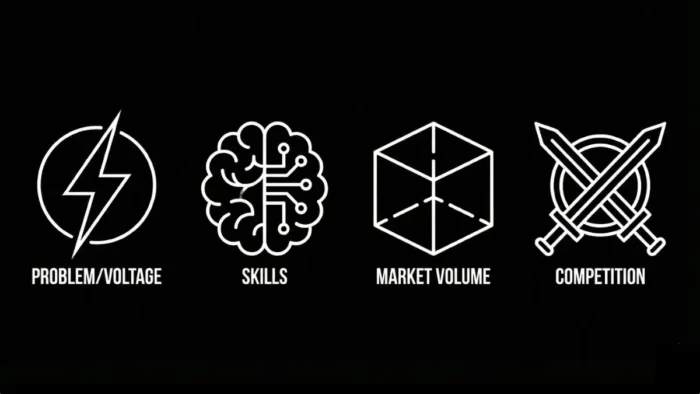
Variable #1: The Magnitude of the Problem (Voltage)
Every business idea must solve some type of problem that exists in the market.
This is the First Law of Business Thermodynamics. Value is created only when a problem is solved.
However, not all problems are created equal. This is where the concept of “Voltage” comes in.
- Low Voltage: If the problem is a minor annoyance—like a mosquito bite—the potential energy is low. People might want a solution, but they won’t pay much for it, and they won’t feel urgency.
- High Voltage: If the problem is urgent and painful—like a broken leg—the potential energy is massive. People need the solution now, and price becomes secondary.
Fall in love with the problem, not the solution.
Uri Levine (Co-founder of Waze)
The Rule: If the problem is more important for customers, the business idea will have larger business potential.
I often tell entrepreneurs: Stop looking for “Vitamins” (nice-to-have). Start looking for “Morphine” (must-have).
If your idea solves a “morphine-level” pain, the inherent energy of the business is automatically higher.
Variable #2: Entrepreneurial Fit (Conductivity)
This is the variable where most founders lie to themselves.
Your idea might be brilliant. It might solve a massive problem. But do you have the skills to execute it?
In our physics model, your entrepreneurial skills are the conductivity of the system. You are the wire that the energy must flow through.
- If you have a high-voltage idea (Great Problem) but zero skills in that domain (High Resistance), the energy flow will be zero.
- Why will you start something that you still don’t have the skills, knowledge, and experience to implement? That is simply setting yourself up for high friction.
The Rule: If you have the appropriate entrepreneurial skills to implement your business idea, the conductivity is high, and the potential energy increases.
This doesn’t mean you need to know everything. But if you are building a complex AI platform and you don’t know how to code and don’t have a technical co-founder, your “Fit Score” is effectively zero.
Variable #3: Market Dimension (Volume)
This is the size of the container.
If your business idea is designed to solve problems for a market of 100,000 individuals, that “container” holds significantly more energy than a niche market of 500 potential customers.
The logic is simple math. Even if you capture 100% of a tiny market, your kinetic energy (revenue) is capped. If you capture 1% of a massive market, your kinetic energy can be enormous.
The Rule: The larger the addressable market, the higher the ceiling for your potential energy.
Related: How to Validate a Business Idea to Become 100% Sure That You Will Succeed?
Variable #4: Competition (Resistance)
Finally, we must look at the environment.
Is there big, medium, or low competition in the market? In physics, competition acts as friction or resistance.
- If you enter a market with Amazon, Google, and Apple as established competitors, the resistance is “Big.” It will take massive amounts of energy just to move an inch. You are trying to push a boulder uphill against a landslide.
- If there is lower competition (a “Blue Ocean”), your energy goes further. You push the boulder, and it rolls.
The Rule:Lower competition equals higher business potential energy.
2. The Calculation: The BPE Scorecard
“In God we trust. All others must bring data.”
W. Edwards Deming
Now that we know the basic metrics, we can stop guessing and start measuring.
We are going to use a technique that ranges business potential energy in a span greater than or equal to 0 and lower than or equal to 1.
To make this actionable, we need to convert qualitative words (Big, Small, Good, Bad) into quantitative numbers.
Here is the Quantification Scale you should use for your analysis. Note closely how we score “Competition”—this is often where people make mistakes.
| Business Element | Condition | Score (Quantification) |
|---|---|---|
| Problem Importance | Big (Urgent/Painful) | 1.0 |
| Average (Annoying) | 0.5 | |
| Low (Trivial) | 0.0 | |
| Skills (Fit) | High Fit (Expert) | 1.0 |
| Average Fit | 0.5 | |
| Low Fit (Novice) | 0.0 | |
| Market Dimension | Big Market | 1.0 |
| Average Market | 0.5 | |
| Small Market | 0.0 | |
| Competition | Low (Blue Ocean) | 1.0 |
| Average | 0.5 | |
| Big (Red Ocean) | 0.0 |
Critical Note on Competition: Notice that “Low Competition” gets a score of 1.0. This is because low competition is good for your potential energy. Conversely, “Big Competition” gets a score of 0.0 because it kills your potential.
Related: 31 Startup KPIs and Metrics to Measure with Examples
3. Example: The Selection Process in Action
Let’s run a simulation to see how this clarifies your decision-making. Imagine you are deciding between two specific ideas:
- Business Idea #1: A specialized SaaS software for a large logistics industry where you have deep personal experience.
- Business Idea #2: A trendy B2C social media app for pet owners. The market is huge, but it is crowded, and you have never built a consumer app before.
Let’s plug them into the matrix:
| Metric | Business Idea #1 (Logistics SaaS) | Business Idea #2 (Pet App) |
|---|---|---|
| Problem Importance | Big (1.0) (Logistics is losing millions due to this problem) | Average (0.5) (People like pets, but it’s not a crisis) |
| Skills (Fit) | High (1.0) (You are an expert here) | Average (0.5) (You are a user, not a builder) |
| Market Dimension | Big (1.0) (Global logistics is massive) | Big (1.0) (Every pet owner) |
| Competition | Average (0.5) (Some old software exists) | Big (0.0) (Facebook, TikTok, Instagram) |
| Aggregate Score | 3.5 | 2.0 |
| Final BPE (Avg) | 0.875 | 0.50 |
Calculation: We divide the Aggregate Score by 4 (the number of metrics we use) to get the BPE index. You can divide by the number of metrics you are using. That’s the beauty of this framework: you can adjust it according to your own needs.
The Verdict: From these two business ideas, the math makes the decision for you. You will choose Business Idea #1 (BPE 0.875) over Business Idea #2 (BPE 0.50).
Idea #1 has a stronger foundation, a better founder fit, and less resistance. Idea #2 is a “trap”—it looks fun, but the physics are working against you.
4. Advanced Physics: The Power of Weighting
If you stop at the simple average, you are doing better than 90% of entrepreneurs. However, if you want to be truly precise—if you want to be a “Business Physicist”—the simple average is not enough.
Why? Because not all variables are created equal.
Equality is a lie in business physics.
- The Importance of the Problem is the “nuclear core” of the idea. It is significantly more important than the market dimension. If you solve a life-threatening problem for a small group of people, you can still build a massive, profitable business (think of a cure for a rare disease).
- If you solve a useless problem for a billion people, you have nothing (think of a generic flashlight app).
Therefore, the better way is to add Weight to each metric. This filters out the “nice to have” ideas and highlights the “must-have” solutions.
Here is my recommended weighting system for the modern market:
- Market Dimension: Weight x1 (Environmental Factor)
- Problem Importance: Weight x3 (Critical Factor)
- Skills (Fit): Weight x2 (Success Factor)
- Competition: Weight x1 (Environmental Factor)

The Weighted Calculation
Let’s re-calculate our example using weights to see the true difference. The total potential “points” available is now 7 (3+2+1+1).
Business Idea #1 (The Logistics SaaS):
- Problem (1.0) x 3 = 3.0
- Skills (1.0) x 2 = 2.0
- Market (1.0) x 1 = 1.0
- Competition (0.5) x 1 = 0.5
- Total: 6.5 / 7 = 0.92 BPE
Business Idea #2 (The Pet App):
- Problem (0.5) x 3 = 1.5
- Skills (0.5) x 2 = 1.0
- Market (1.0) x 1 = 1.0
- Competition (0.0) x 1 = 0.0
- Total: 3.5 / 7 = 0.50 BPE
The Analysis: Look at what happened. The gap widened. In the unweighted calculation, Idea 1 was better (0.875 vs 0.5). In the weighted calculation, Idea 1 is elite (0.92), and Idea 2 is exposed for what it really is: mediocre (0.50).
The weighting system punishes Idea #2 heavily because it attempts to solve a weak problem with weak skills—the two most important factors.
5. The Decision Matrix: What Your Score Means
Now that you have a number, what do you do with it?
You need a threshold. You need a “Go / No-Go” gauge. Based on my experience analyzing business models, here is how you should interpret your Weighted BPE Score:

The Red Zone (< 0.50)
The essence of strategy is choosing what not to do.”
Michael Porter
Verdict: KILL.
Do not proceed. Do not pass Go.
An idea with a score this low has too much internal resistance. The problem isn’t painful enough, or the competition is too fierce.
If you pursue this, you are choosing a life of struggle.
The Yellow Zone (0.50 – 0.75)
Verdict: OPTIMIZE.
This is a decent idea, but it has leaks.
If your “Skills” score is low, find a co-founder who raises the average.
If your “Competition” score is low (meaning high competition), can you niche down to a specific sub-market to turn that score into a 1.0?
Do not launch yet. Pivot the parameters until the score improves.
The Green Zone (> 0.75)
Verdict: EXECUTE.
This is a winning system.
The physics are aligned in your favor.
You have a high-value problem, the right skills to solve it, and a market that can sustain it. Stop analyzing and start building.
The Bottom Line
This entire process—from the initial definition of Energy to this final weighted calculation—is designed to do one thing: protect your time.
Time is the only resource you cannot regenerate. You can get more money. You can hire more people. But you cannot get back the three years you spent building a “Business Idea #2” that was doomed by physics from day one.
When you calculate BPE, you are objectively testing the structural integrity of your dream before you build the house.
Here is your assignment for this week:
- List your top 3 business ideas.
- Be honest with yourself and grade them using the Weighted System.
- Choose the one with the largest energy.
If you have a Green Zone idea, you have a green light. You have the formula. The rest is just execution.


