We all want to finish our projects. And yet, we often end up with a bunch of half-finished, or even abandoned, projects. This post explores what you can do when you think about projects and get started on them but don’t complete them.
If you’re like me, you probably find yourself juggling multiple projects at once. You know there are some things you really should do but are too busy to focus on them.
It’s easy to fall into the habit of completing projects half-heartedly. The trick is to ensure you finish them as efficiently as possible so you don’t lose too much time on any given project.
A few years ago, I realized I was spending far more time on unfulfilled projects than on those moving forward. I decided to focus all my attention on the projects I felt could be completed in my own time. This shift in strategy has worked.
You can finish more projects more effectively if you get yourself organized! Learn how to develop a better project management system and get your projects done faster.
Do you have experience starting several different projects and, after some time, conclude that you can’t finish them? Do you have too many half-finished projects?
Table of contents
How many half-finished projects do you have?
Stop for the moment and take a piece of paper to write!
Write a column with a title like “current projects” and list all your current projects which you are working on now.
Make another column titled “half-finished projects,” and write all unfinished projects that are in temporarily standby mode.
Next, continue with a third column titled “future/ideas,” where you will list projects that you plan to start later.
You can also use a spreadsheet tool like this below, where you can write all of your current (in-progress), half-finished, and future projects.
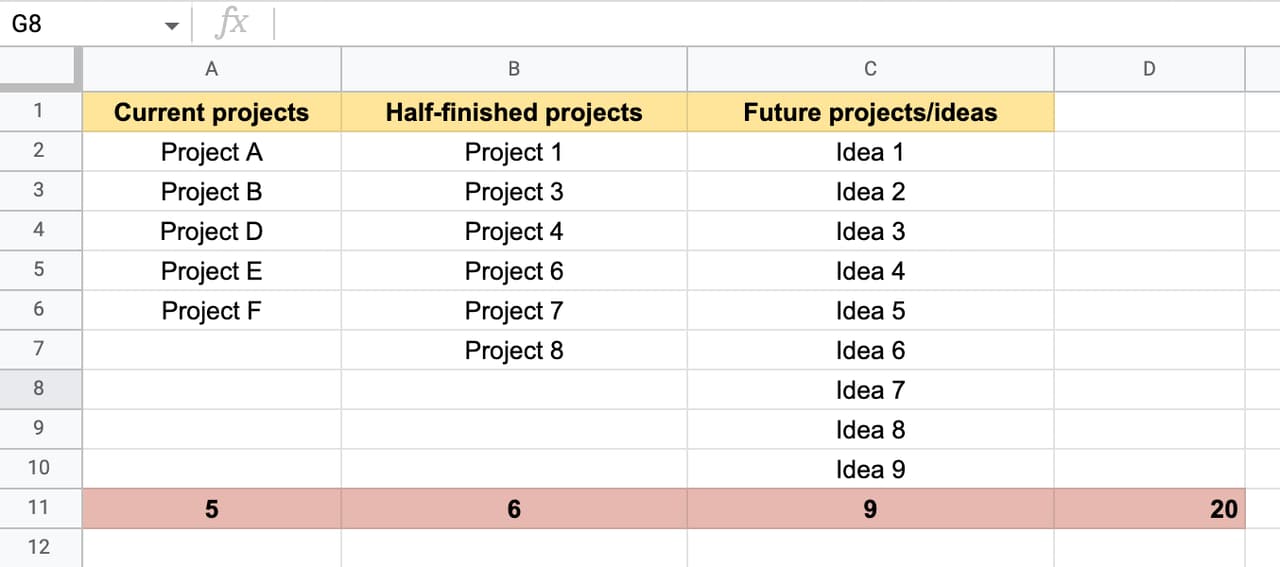
As you can see from this simple example, there are 20 different projects inside the mind of an entrepreneur in this case. This is a large number, but remember that in reality they can be much more than 20. When I did this exercise, my number was 47.
Now, make simple math. For how many projects are you responsible?
What to do with your half-finished projects?
But, the sad truth is that your half-finished projects are something in which you have already invested so much time, money, and other resources. Are they something that you need to give up right now?
- You start with a basic idea.
- You are so excited about the new idea and started working on it.
- Then, you transform your idea into a project.
- Then, you start through the action steps defined in your project.
- You work hard to start and walk through the steps.
- Then, for some reason, you lose your excitement.
- Now, you don’t know what to do next.
Why don’t you know what to do next?
Because you probably have started another project, then another, then another, etc. Because you have much higher expectations than you need to, you lose your most important energy that was the key driver to work on that specific project.
I have experienced such situations very often. And I can only say that it is so stressful and exhausting. If this didn’t happen to you, then you are a very lucky person.
Let’s start with the first question: what to do next with these half-finished projects. Then, what you can differently do that will enable you to avoid such a situation.
Related: How Do I Get a Copy of The Deed to My Property in Florida?
Steps You Need to Take With Your Unfinished Projects?
There is a lot of value in the projects you don’t complete. Whether because of life or business commitments, they represent the energy you have left over after a task, project, or event.
If you’ve ever made a mistake and you feel stuck, you can do one of three things with your unfinished project:
- You can either let it linger there until you feel ready to tackle it again,
- You can remove them from your list of unfinished projects and lose your prior efforts to work on them,
- Or you can take the initiative and tackle it as soon as possible.
I know you are already working on something different, but let’s try to save what can be saved.
Here, I want to present one possible solution or something that I call “save what you can save.”
1. How much time you can spend analyzing the potential of unfinished projects
First, decide about the time you can spend analyzing the potential of your half-finished projects. You need to spend some time not on finishing projects but on deciding what you want to finish, what will stay on your standby list, and what can be removed from the list.
2. Analyze your half-finished projects
Second, start with the analysis of half-finished projects. You need to rank them. The critical criteria can be the project’s return on investments, the time you need to complete it, and the resources you will need to use for that.
You must understand the time you need to spend on the project. You can estimate how long it will take you to finish the project. The more details you know about the project, the better. This is an essential step for you to get a rough idea of how long it will take you to finish the project. You can also look at the resources you will need for the project. The more details you know about the project, the better. It can be very frustrating if you don’t know anything about it.
3. Prioritize the projects
Now when you have your list, you can prioritize the projects. The following rules can make the prioritizing: the projects with the larger return of investments, the shortest time required to be accomplished, and the minimal required resources to be allocated will have the highest priority to start working on. The second group of projects can be one that will stay on your standby list, and the last group of projects that you can simply forget will be all that have a low return on investment, a significant amount of time to be finished, and will need a large number of your business resources.
You can prioritize your projects based on their order of importance and how urgent they are. Some say that the projects that require the least amount of money, the shortest time, and the lowest amount of resources are the most important ones. This may or may not be true, but you will know better when you try this out yourself. It’s easy to prioritize your projects when you use the prioritizing rules.
4. Start Working
Once you decide which half-finished project to begin, just start doing it. You should start working on the first item on your priority list. The next thing to do is select when you will work on your project. If you are working on something at home, you can work whenever you have time. If you are working on your project at the office, you can choose a particular time to work on your project.
Once you complete the first item, move to the next one. Try to finish all the items on your list. Keep this process going until all the items on your list are completed.
How Can You Avoid Situations With a Large Amount of Half-Finished Projects?
Now, I explained a possible process of how to start doing something with your half-finished projects as a reactive approach. But, what we need is a proactive approach. Something that will not put us in such situations where we try to save what we can save.
The best way to avoid problems is to start a project you can’t complete.
Instead of being reactive, you need to be proactive. When you start doing things, you should focus on the outcomes you want to achieve. You must think about creating your future and making it happen. You must think about ways to improve yourselves and get what you want. Before starting something, you should make sure you have thought about all the possibilities, risks, and potential consequences.
Let’s continue with some proactive tactics that will give you the possibility to escape becoming a part of such a situation.
1. Start using a business ideas book.
A business ideas book is where you collect each of your business ideas. But, it is where ideas stay without judgment. The idea can be translated into a possible project only when you evaluate it and you are sure that the idea is worth to be implemented. A business ideas book is the place where will be all your basic ideas.
You might be wondering what exactly a business ideas book is. It is a place where you keep all your ideas in one place. That is where you can store your ideas and later analyze and evaluate each idea. For example, if you have an idea about a new product or a service, you can write it down. You can use this place as a memory jogger so that you can remember the idea at a later time. You don’t have to worry about being too selective with your ideas. The business ideas book is a place where all ideas are welcome. Remember, these are only ideas for projects, not projects.
2. Implement a system for evaluating your ideas.
You need a robust system for the evaluation of your ideas. Suppose you don’t have such a system in place. In that case, you will come in the position to have a business ideas book with too many ideas that will simply stay in the book without any future actions to take about them. In such a situation, you will simply ignore your business ideas book. With the system in place, you will have one day in your week when you will evaluate your ideas. At least, you will schedule some subsequent basic actions about each of the ideas, or you will simply delete some of them without the need for future actions.
3. Prioritize your ideas.
Based on the evaluation of each of your ideas, you can prioritize them, which will show you what can be implemented as a first and what can continue to stay on the standby list.
Your goal is to choose an idea that you think you can put into practice in your life. Remember that your priorities and your goals are all your own. They’re not anyone else’s. What you are choosing to focus on is yours and yours alone. Don’t let others dictate what you should be doing or what you can or cannot do.
The highest priority ideas will be the ones that you will implement first. The second priority ideas will be the ones that will be implemented second. After you have prioritized the ideas, it will be easier to implement them.
4. If you can’t finish something alone, start delegating.
When you finish your active project, you can simply start with the first of the ideas on your list as a new project. If you think you can’t finish something alone, start delegating some of the activities to your business members.
5. Don’t start another project without finishing one already started.
One important rule you need to use is not to start with another project until you don’t finish one that has already started. So, you will finish all your projects if they are already started. But, in some exceptional situations, you can decide to stop working on some of your current projects because of the wrong expectations. If you discard some of your projects, discard them without using your standby list. Simply forget about them and start with the next one.