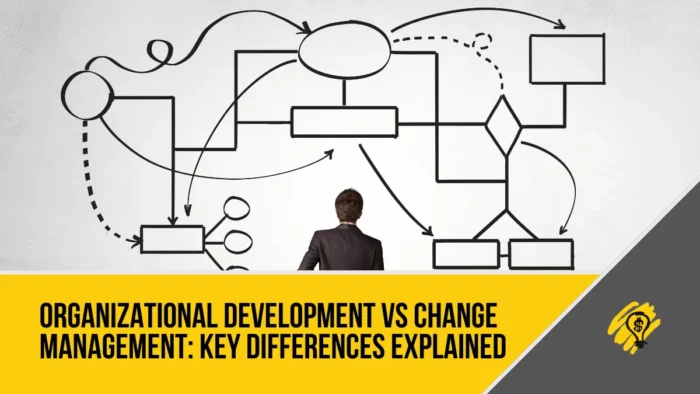

What’s the difference between organizational development vs change management? Organizational development is about long-term growth and adapting to change by building a resilient culture. On the other side, change management is about specific changes being implemented and accepted.
This article will cover these key differences and how they can work together to deliver organizational success.
📖 Key takeaways
- Organizational Development (OD) involves long-term, systemic change of entire organization to improve an organization’s overall health and effectiveness. Change Management (CM) involves specific changes triggered by external forces to smooth the transition and acceptance.
- OD and CM work together; OD provides the strategic framework for aligning organizational goals, and CM the tactical execution of change, resulting in effective and sustainable organizational transformation.
- OD practitioners and Change Managers require different skill sets. OD practitioners need emotional intelligence, business acumen, and strong communication skills, while Change Managers need project management, clear communication, leadership, and stakeholder engagement skills.
Introduction to Organizational Development and Change Management
In today’s organizations, we need to understand Organizational Development (OD) and Change Management (CM). Both are essential for organizational success, each bringing different strengths to the table. This blog will explore the differences and connections between organizational development and change management and how they contribute to organizational efficiency and adaptability.
We have already covered many change management models or frameworks and you can see that many of them can already include organizational development:
- The Bridges Transition Model for Effective Change Management
- Change Equation: Managing Complex Change in Your Company
- Burke-Litwin Change Model for Effective Change Management
- Lewin’s Change Management Model
- Kotter’s 8-Step Change Model
- The Diagnostic Model of Organizational Change?
So, we will put our focus more on organizational development. Here, you can find information on the key aspects of organizational development and change management, as well as business processes, methodologies, and skills for practitioners.
Let’s start by explaining both concepts.
What is Organizational Development?

Organizational Development (OD), or organization development, is a strategic, science-based approach to improve an organization’s long-term effectiveness. Unlike reactive measures, where companies react to external changes, organization development is a continuous and planned process to improve the entire organization’s health. Focusing on systemic change helps organizations adapt and thrive in today’s fast-changing business environment.
At its heart, OD is about an organization’s human and cultural aspects. This includes developing and promoting a positive organizational culture, communication, and employee engagement and satisfaction. OD interventions, such as group interventions, team building, leadership development, and strategic planning, aim to align the organization’s values and operations with its strategic objectives.
Definition of Organization Development
During the late 1950s and early 1960s, the term “organization development” (OD) began to gain traction. There are many definitions of organizational development. The definition that is most often used in the literature is proposed by Richard Beckhard, who defines organizational development as:
- planned attempt,
- which applies to the entire organization,
- and is managed by top management,
- to increase organizational effectiveness and good condition through
- planned interventions in organizational processes using knowledge from behavioral science.
As you can see, when we talk about organization development, it is a planned attempt meant to cover the entire organizational system.
Organizational Development Processes and Models
Different tools, or many OD interventions, have appeared first due to advancements in behavioral science. Let’s look at some of them:
1. Action Research Model
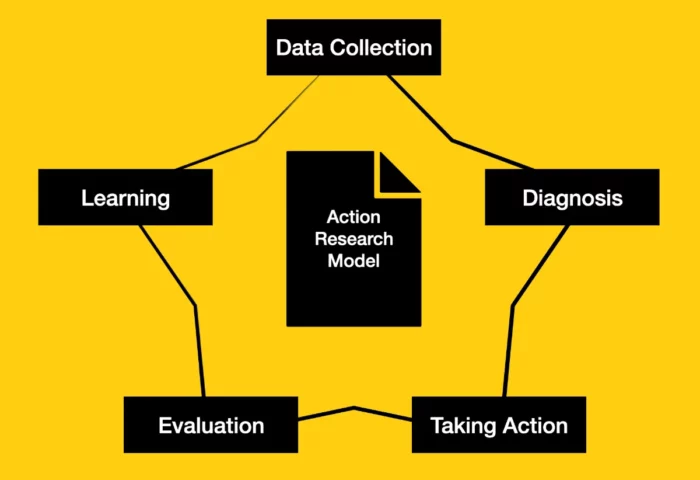
The action research model is a collaborative approach linking research closely to action. In such a way, this model enables organization members to use it to implement change. This intervention involves joint efforts between organization members and researchers to collect, analyze, and use data about organizational dynamics and functioning.
The phases of the action research model include systematically collecting data about an ongoing system relative to some objective, analyzing the data for diagnosing purposes, taking action based on the diagnosis, evaluating the results, and learning by measuring achievements.
The goal is twofold: solving immediate practical problems and contributing to scholarly knowledge. Over time, variations like action science and participatory action research have emerged, emphasizing scientific inquiry and the full participation of organization members in the research process.
2. Sensitivity Training
Sensitivity training is an OD intervention that originated in the summer of 1946 in New Britain, Connecticut when Kurt Lewin conducted a workshop to improve community leadership and interracial relationships. The training involved lectures, role-playing, and group discussions. Participants observed evening staff discussions and received feedback about their daytime behavior, which proved highly educational.
This intervention evolved into unstructured small group discussions where the primary learning source was the behavior and feedback of group members. Sensitivity training was later applied to organizational settings, where it was used to promote participative management and improve interpersonal relationships within teams for better performance management. However, the lack of structure sometimes posed challenges, leading to the development of more structured approaches like the next one.
3. Team Building Intervention

Team building is an organizational development intervention that improves work teams’ processes and relationships.
Unlike sensitivity training, which was unstructured and often caused problems when participants returned to their hierarchical roles, this OD intervention is focused on work-related issues and maintains hierarchical relationships. It uses various methods, such as process consultation, consensus building, professional development, and conflict resolution strategies, to enable team members to work together more effectively.
Over the years, this organizational development model has spread to many contexts, including self-directed work teams, Total Quality Management (TQM) strategies, performance management, and cross-functional teams, and often involves outdoor activities to build reliance on each other.
Related: 29 Proven Team-Building Activities to Increase Teamwork Success
4. Sociotechnical Systems
Sociotechnical systems (STS) is an approach to organization development that considers both the social and technical aspects of a workplace. It originated in the 1950s when Eric Trist of the Tavistock Institute worked with a coal mining company that was facing productivity issues due to new equipment. Trist and a foreman, Bamforth, redesigned the work to combine the social elements of teamwork with the new technology, which improved productivity and reduced absenteeism.
The core idea of STS is that organizations are both social and technical systems, and both need to be optimized together. This means designing work processes considering human interactions and technical efficiency to achieve positive outcomes in both areas. Over time, STS has evolved and influenced programs to improve work-life quality.
5. Quality of Work Life (QWL)
Quality of Work Life (QWL) programs began in northern Europe in the 1960s and later spread to the United States. Rooted in the tradition of sociotechnical systems, these programs aim to improve employees’ work experiences and talent management by involving unions and management in designing jobs with high levels of discretion, task variety, and feedback.
In the U.S., the QWL movement created joint labor-management teams outside traditional bargaining agreements to solve common workplace problems. To improve employee productivity and satisfaction, these teams implemented various initiatives, such as autonomous work groups, career development programs, and improved reward systems.
Although original QWL programs are less common today, they paved the way for modern organizational interventions like self-managed work teams, where employees have more control over their work and decision-making processes. These interventions focus on improving compensation, work environments, professional development, personal growth, and the balance between work and personal life, ultimately contributing to employee well-being and organizational effectiveness.
6. Survey Feedback
Survey feedback is an organizational development model that originated in the 1940s at the Institute for Social Research (ISR) at the University of Michigan. It involves using questionnaire surveys to collect data on employee morale and attitudes. The process has two main steps:
- Collecting survey data to understand employees’ perceptions of various factors within the organization;
- Providing feedback on the survey results in a structured manner down the hierarchy. This feedback is followed by discussions between supervisors and their teams to interpret the results and develop action plans for employee growth and improvement.
The key to successful survey feedback is the joint effort of managers and their subordinates in discussing the data and planning changes together, which leads to significant positive changes in the organization.
7. Organizational Transformation
Organizational transformation is an OD model that changes an organization’s vision, mission, strategy, and operating philosophy. It’s a big and tough process requiring much time and resources. Leadership, particularly from the CEO, is key to transformation. The CEO has to generate energy for change, develop a clear future vision, align the organizational context to close the gaps between current and desired states and create a transformation architecture involving education, involvement, communication, coordination, and feedback mechanisms.
Transformation can be categorized into four types of change:
- Tuning (incremental and anticipatory),
- Adaptation (incremental and reactive),
- Reorientation (strategic and anticipatory), and
- Re-creation (strategic and reactive).
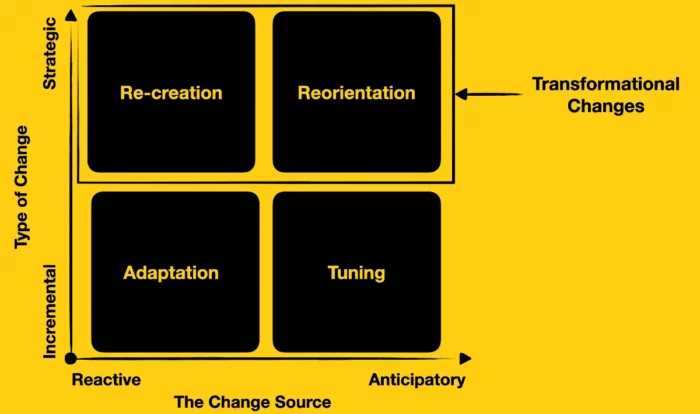
The latter two, reorientation and re-creation, are transformational as they require unlearning old habits and learning new ones. This model highlights the need for a new business strategy and vision, as well as for managing disagreement among organization members to get to the desired future state.
8. Large-Scale Interventions
Big interventions are an organizational development (OD) model for transformation or big organizational change. Unlike traditional action research, which starts with a specific problem, big interventions start with visualizing a desired future state for the organization.
This approach emerged in the 1980s and has since evolved into various system-wide, big-group interventions. These shift the focus from individual or group interventions to changing the whole system to achieve the desired future. Some examples of big interventions are:
- Open Space Technology is where a large group of people come together to discuss issues or opportunities around a central theme. Participants propose topics, form groups, create reports, and have a very participative and flexible environment.
- Future Search is a future-oriented conference where participants come from diverse backgrounds and interests. Over three days, they explore past and present trends, brainstorm ideal futures, and develop action plans for common goals.
- Real-Time Strategic Change (RTSC) is a large conference where employees critique and revise top management’s strategic proposals. This ensures broad participation and immediate feedback and empowers employees.
These big interventions involve many stakeholders in the change process, moving the whole organization towards a common future. They are participative, flexible, and provide real-time feedback, so they are great tools for organizational change.
9. Learning Organizations
For years, we’ve known that organizational systems and their members learn and it is part of organizational talent management. Initially, organizational learning was seen as a change in behavior in response to a stimulus. Over time, the concept evolved to include both behavioral and cognitive elements and to challenge and change routines.
A learning organization expands its capacity to create its future by integrating adaptive and generative learning. Peter Senge’s book “The Fifth Discipline” outlines the five disciplines for learning organizations:
- Systems Thinking and Holistic Approach: Seeing interdependencies and patterns that influence action.
- Personal Mastery: Commitment to lifelong learning and personal vision.
- Mental Models: Reflecting on and challenging deeply held assumptions.
- Building Shared Vision: Developing collective goals and guiding principles.
- Team Learning: Maximising individual insight through group interaction.
Learning organizations focus on building organizational capacity for continuous learning across the organization. This means having a strong shared vision, open conversation, and using tools like learning histories to reflect on past experiences. The goal is to have an organization that can adapt and improve continuously, be resilient, and be effective in the long term.
10. Appreciative Inquiry
Appreciative Inquiry (AI) as an organization development (OD) model was born in the mid-80s in the last century and is now one of the most widely used OD interventions globally. AI is based on the assumption that social systems are socially constructed and that focusing on the positive in an organization can drive change more than focusing on the problems.
AI uses storytelling, narratives, and visions to stimulate human imagination and expand the possibilities for new social constructions. It uses positive imagery and effect, as well as more action and engagement than negative perspectives. AI aims to build consensus around these by focusing on the positive and creating a supportive and affirmative organization culture.
Despite its popularity, AI has been criticized for its reliance on practitioner-based sources and for not addressing the negative in organizations. But it’s still a powerful tool for transformational change because it uses the positive in social systems.
What is Change Management?
Change management is a process that guides individuals, teams, and organizations through specific changes to ensure smooth implementation and lasting benefits. Unlike organizational development, which takes a broad systemic view with a focus on human resources, change management focuses on managing specific changes, such as introducing new systems, processes, or policies in the organization.
As you can see, change management seeks to minimize disruption and ensure changes are well-prepared, implemented, and accepted by the organizational members. This requires clear communication, training, and support to help human resources understand and adapt to the change. Also, change management must reduce resistance and facilitate transitioning individuals by addressing change’s technical and human aspects.
As we have already covered many change management frameworks, you can see that this process uses various tools and techniques for project teams to manage change, such as impact assessments, detailed change plans, and resistance management strategies. Change agents are key to the success of change initiatives, keeping the organization on track and employees supported through the transition.
Focusing on specific changes and a structured approach, change management helps organizations to successfully manage all the complexities of the change process and deliver new initiatives and outcomes.
Organizational Development vs Change Management
While both Organization Development (OD) and Change Management (CM) are about improving organizational effectiveness, they are very different in scope, focus, and approach. Organizational development takes a holistic approach and long-term view, intervening broadly to shape organizational components and overall health. On the other side, change management targets specific projects or initiatives, focusing on achieving results by changing individual and organizational behavior.
Organizational development is a continuous process that can take years, involving systemic changes to align the organization’s values, culture, and operations with its strategic goals. However, change management is about specific issues with a shorter time span, often linked to immediate needs and new ways of working.
Let’s look at these core differences between both approaches:
Scope and Focus
Organization development (OD) takes a big-picture view, for entire organization. The OD process looks at the broader impacts of change and how individuals and teams move within the organizational structure.
Change Management (CM) targets specific projects or initiatives and focuses on achieving specific outcomes by changing individual behavior. CM has a defined scope, often related to specific planned changes such as technology implementations or policy changes.
Time Horizon
Organization development (OD) is long-term and continuous. It can take years to fully implement and realise the benefits. OD builds the organization’s capacity to assess how it’s currently performing and make strategic adjustments to achieve long-term goals. This process is also known as organizational development and ensures a sustainable future for the organization.
Change Management (CM) usually addresses specific issues within a shorter time span, focusing on immediate needs and new ways of working. CM is short-term and project-based, deals with immediate changes, and ensures smooth implementation.
People vs Process Orientation
Organizational Development (OD) focuses on:
- People and company culture within the organization, including professional development
- Company actions aligned with employee satisfaction and overall goals
- Positive organizational culture
- Human dynamics for sustainable change.
Change Management (CM) focuses on processes and systems, involving key stakeholders to achieve outcomes and provides structured methods to support individuals through change. CM ensures changes are implemented quickly and employees can adapt to new processes and systems.
How Organizational Development and Change Management Work Together
Organization Development (OD) and Change Management (CM) are not mutually exclusive; rather, they complement each other to drive successful organizational change. The organizational development process provides the strategic framework to ensure alignment with vision, values, and business strategy during organizational changes. CM focuses more on tactical execution, and, in such a way offers structured processes and tools to implement transitions without problems.
By integrating the organizational development process and change management process, organizations can:
- Incorporate a continuous improvement process
- Create a resilient foundation for change
- Prepare individuals to adapt effectively
- Enable strategic shifts that are essential for a company’s progress and durability.
OD and CM Have Complementary Roles
Organizational development and change management function synergistically in organizational change. OD aligns organizational goals with employee needs, providing a strategic framework for change. Meanwhile, CM ensures that changes are well-prepared, smoothly implemented, and accepted by the team.
Also, organizational development evaluates the wider organizational context and strategy for transformation, whereas change management converts this into comprehensive action plans and tools. This alignment of strategy and implementation ensures that changes are effectively integrated into the organization’s operations.
Integration of OD and CM Approaches
Combining Organisational Development (OD) and Change Management (CM) greatly impacts organizational performance. By mixing OD’s strategic framework with CM’s tactical execution, organizations can navigate the strategic shifts needed for progress and sustainability. This integration creates a dynamic, agile work environment for continuous improvement and resilience.
Good change management increases the chances of project success by 7 times compared to no change management or poor change management. Projects with good change management have:
- Higher adoption and usage rates
- More ROI
- Less turnover
- More productivity
This combined approach means effective organizational improvement efforts lead to changes that are well-prepared, implemented, and accepted by employees, and the business moves forward with purpose and resilience.
By combining OD and CM, organizations can create a constant change-resilient foundation and prepare individuals to adapt. This synergy enables the strategic shifts needed for the business to progress and sustain. By embracing OD and CM, organizations can navigate the change complexities and drive continuous improvement and long-term success.
Organizational Development Phases

Organizational Development (OD) has five different phases that guide implementing and sustaining organizational change. The phases of OD are the following:
- Entry. Initially, the OD consultant will be engaged with the organization and identify areas for improvement and desired outcomes.
- Diagnosis. At this stage, the OD consultant identifies the root causes of organizational issues and problems that limit organizations from achieving desired outcomes.
- Feedback. This stage of organizational development models involves providing actionable information to the client.
- Solution. At this stage, interventions are designed and implemented.
- Evaluation. The last stage is evaluation, which assesses the outcomes of the OD process to ensure continuous improvement.
These phases provide a systematic approach for identifying and addressing organizational issues, including improving an organizational process aimed to improve the entire company.
Skills Required for OD Practitioners and Change Managers
Organizational Development (OD) practitioners and Change Managers need specific skills to manage change. Let’s see what’s required for practitioners in both:
Skills for OD Practitioners
OD practitioners need to have various skills related to change. Firstly, emotional intelligence is a must, as it helps practitioners manage the emotional problems that comes with change. Understanding and managing emotions in self and others is key to creating a change-friendly environment.
Also, business knowledge is required to link OD interventions to the organization’s strategic goals and objectives. Communication and collaboration skills are key to working with stakeholders, facilitating dialogue, and building effective teams.
Conflict management and innovation are also important so that OD practitioners can resolve conflicts and develop creative solutions to organizational problems.
Skills for Change Managers
Change Managers need specific skills to manage and implementing change management process. Project management skills are required to plan, execute, and oversee change initiatives to ensure they are delivered on time and to budget. Communication skills are key to educating employees about the change, reducing and overcoming resistance to change, and getting buy-in.
Leadership skills are also required, as Change Managers need to lead their teams through the transition. Stakeholder engagement skills are also required so that all parties are informed, supportive, and aligned with the change goals. Training and problem-solving skills are also required to deal with challenges and ensure a smooth transition.
FAQs
The main difference between Organizational Development (OD) and Change Management (CM) is that OD is a long-term, whole-system improvement for the organization. At the same time, CM involves specific changes with a structured approach for implementation and employee adaptation.
OD and CM work together to provide a strategic framework that aligns organizational goals with employee needs and focuses on tactically executing changes to get the team’s buy-in.
In summary, the challenges in OD are resistance to change, leadership development, burnout, ineffective leadership and conflicts, and changing the mission or values. These will impact organizational development.
Change Managers need project management, clear communication, leadership, and stakeholder engagement skills. These are key to implementing and managing change in the organization.
Integrating OD and CM will create a dynamic, agile workplace with strategic progress, resilience, and organizational performance. It will get the business moving with purpose and resilience.