As an entrepreneur, you will always need some tools to perform a different analysis. One of the most important analyses for businesses is the SWOT analysis. Because of that in this post, I would like to share such a tool in the form of a SWOT analysis template.
📖 Key takeaways
- Utilize a free SWOT analysis template to effectively evaluate your business’s internal strengths and weaknesses, as well as external opportunities and threats, to inform strategic planning.
- Conducting regular SWOT analyses helps small businesses stay proactive, adapt to market trends, and develop strategies that capitalize on strengths while addressing potential threats.
- A comprehensive SWOT analysis provides valuable insights into your business environment, enabling informed decision-making and improving overall business performance.
What is SWOT Analysis and its Internal and External Factors?
SWOT analysis is a strategic planning tool that involves conducting a comprehensive SWOT analysis to thoroughly evaluate a company or project.
A SWOT analysis is a powerful strategic planning tool designed to help you identify and evaluate your business’ Strengths, Weaknesses, Opportunities, and Threats (SWOT).
When you analyze these four components, you can fully understand your business’s environment regarding internal and external factors. The primary purpose of a SWOT analysis is to provide a fact-based framework that guides your future business decisions.
This structured approach enables you to make informed decisions, capitalize on your strengths, address your weaknesses, seize opportunities, and mitigate potential threats.
Whether you’re a startup or an established company, incorporating a SWOT analysis into your strategic planning process can significantly enhance your decision-making capabilities.
Related: Social Media SWOT Analysis With 40 Questions
The Components of SWOT Analysis
A SWOT analysis is composed of four key components: Strengths, Weaknesses, Opportunities, and Threats. Each component plays a crucial role in painting a complete picture of your business environment.
- Strengths: Strengths are the first factors you analyze in SWOT analysis. These are internal attributes that give your organization a competitive edge. Examples include a strong brand reputation, a loyal customer base, or proprietary technology.
- Weaknesses: The second factors you must analyze to conduct a SWOT analysis are weaknesses. These are internal attributes that may hinder your organization’s performance. Common weaknesses might be a lack of resources, outdated technology, or poor customer service.
- Opportunities: These are external factors that your organization can leverage to achieve its goals. Opportunities could include emerging market trends, technological advancements, or changes in consumer behavior.
- Threats: These are external factors that could negatively impact your organization. Examples of threats include new competitors entering the market, economic downturns, or regulatory changes.
By clearly defining and categorizing these components, you can develop a strategic plan that addresses all aspects of your business environment.
When to Use a SWOT Analysis Template: Key Use Cases
A SWOT analysis template I will share here is a universal tool that can be applied in various use cases to improve your business strategy.
Here are some key use cases when conducting a SWOT analysis can be particularly beneficial:
Strategic Planning
Utilize a SWOT analysis template during the strategic planning process to gain a comprehensive understanding of your business environment. By identifying internal strengths and weaknesses, along with external opportunities and threats, you can develop informed strategies that align with your organization’s goals.
Market Entry
When entering a new market, a SWOT analysis helps assess the competitive landscape. It allows you to identify potential opportunities for growth and recognize threats that could impact your success, enabling you to tailor your market entry strategy effectively.
Product Development
Use a SWOT analysis to evaluate the viability of a new product or service. By examining internal capabilities and external market conditions, you can identify areas for improvement and potential challenges, ensuring your product is well-positioned for success.
Business Expansion
Before expanding your business operations, conduct a SWOT analysis to evaluate the potential risks and rewards. This analysis will help you understand the strengths you can leverage, the weaknesses you need to address, and the opportunities and threats present in the new market.
Competitive Analysis
SWOT analysis is a valuable tool for understanding your position relative to competitors. By comparing your strengths and weaknesses against those of competitors, you can identify areas where you have a competitive edge and areas that require improvement.
Crisis Management
In times of crisis, a SWOT analysis can help you quickly assess the situation and develop strategies to mitigate threats while capitalizing on any emerging opportunities. This proactive approach can enhance your organization’s resilience.
Performance Evaluation
If you regularly conduct SWOT analysis, it allows you to monitor your organization’s performance over time. By tracking changes in the internal and external environment of your company, you can adapt your strategies to maintain or improve your market position.
By leveraging these use cases, this SWOT analysis template can provide valuable insights and guide your business decisions, ensuring you remain proactive and competitive in a dynamic business environment.
How to Use This Free SWOT Analysis Template?
Every business is different, and because of that, there are different needs in the implementation of every type of analysis. This editable SWOT analysis template is a two-sheet template.
Step 1: Scan Your Business Internal and External Environment
Both internal and external environments have some specific internal and external factors you must take into consideration.
Internal SWOT Analysis Factors
Internal factors are elements within your organization that you can control and influence. In SWOT analysis, these factors are divided into two main groups of factors: strengths and weaknesses.
Strengths are the positive attributes that set your business apart, such as a skilled workforce, strong financial health, or innovative products.
On the other hand, weaknesses are areas where your business may be lacking, such as limited resources, inefficient processes, or gaps in expertise.
You must identify these internal factors, which is crucial for you to understand what your business does well and where there is room for improvement. In such a way, you can focus on internal factors, build on your business’s strengths, and address your weaknesses to improve your overall business performance.
External Factors
External factors in SWOT analysis are elements that are outside your organization and can impact on your business success but are simply beyond your control. Their source comes from outside of your company, something you can not have full control of in your own hands like it is with the internal environment.
These factors are categorized into two main groups of factors: opportunities and threats.
Opportunities are external conditions that your business can exploit to achieve its objectives, such as favorable market trends, technological advancements, or changes in consumer preferences.
Conversely, threats are external challenges that could hurt your business, such as increased competition, economic instability, or regulatory changes. For example, you can not impact new products from your competition. However, you can analyze their results with such a product and work on improvements of your own products or launch a new product development process as a response to competition.
As you can see, when you understand these external factors, one of the most important things is to anticipate all possible potential challenges and identify all possible areas for improvement and growth. In such a way, you can develop strategies to capitalize on the best opportunities and overcome potential threats, ensuring your business stays resilient and competitive.
Group Internal and External Factors into SWOT Components
Once you have scanned your business environment and identified the relevant internal and external factors, the next step is to categorize these factors into the four components of the SWOT analysis: Strengths, Weaknesses, Opportunities, and Threats.
Let’s look at the steps you must conduct in this stage of your SWOT analysis:
- Begin by listing all the internal factors you have after you analyze your environment as a part of a SWOT analysis, focusing on those factors that give your business a competitive advantage.
- Consider aspects such as unique resources, strong brand recognition, skilled workforce, or innovative technology. These strengths are the internal attributes that set your business apart from competitors.
- Next, identify the factors inside your company that might hurt your business performance, such as limited resources, outdated processes, or gaps in expertise. Recognizing these weaknesses helps you understand areas where improvement is needed.
- Identify factors that are outside your business and that you can leverage them to achieve your business goals. Look for some specific favorable market trends, new technologies, or changes in consumer preferences that simply align with your business objectives.
- Finally, pinpoint these external factors that could be challenges to your business. These might include new competitors, economic downturns, or regulatory changes. Understanding these threats allows you to develop strategies to minimize their impact on your business success.
By systematically categorizing these factors, you can construct a clear SWOT matrix that offers valuable insights into your business environment. This structured approach aids in strategic planning, helping you capitalize on strengths and opportunities while addressing weaknesses and threats effectively.
Now, you have the classification of external and internal factors into your strengths, weaknesses, opportunities, and threats.
Step 2: What do you need to do in the first sheet of the SWOT analysis template?
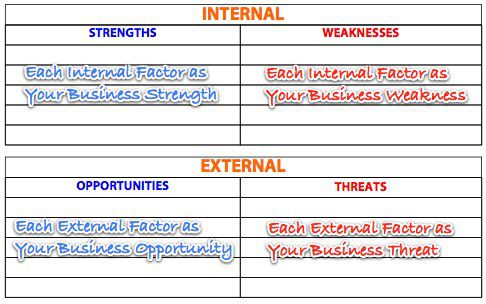
You must construct your SWOT matrix on the first sheet of the business SWOT analysis template I am sharing here, as you can see in the image below.
Internal factors go to the strengths and weaknesses as part of the SWOT matrix, while external factors go to opportunities and threats.
In the article titled SWOT Analysis – 4 Steps, I note the fundamental questions that will guide you through this process of the first two steps in the SWOT Analysis process.
Step 3: What do you need to do in the second sheet of the SWOT analysis template?
On the second sheet, you will need to take the last step of this process to conduct an effective SWOT analysis.
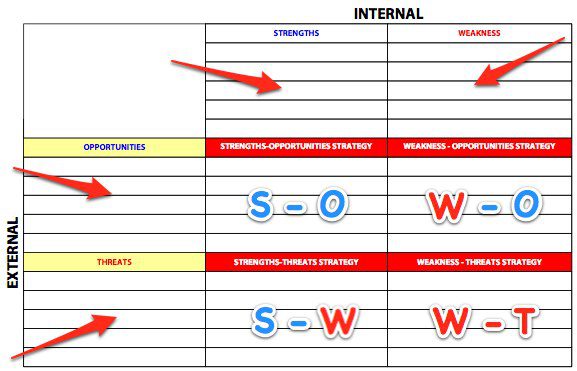
This step is to define the strategies you will need to implement in the future for your small business. As I noted in the previous post, there will be four different strategies:
- S-O Strategies (Strength-Opportunities Strategies). These strategies should take advantage of opportunities that fit the strengths of the business.
- W-O Strategies (Weaknesses-Opportunities strategies). These strategies should enable it to overcome the weaknesses of the business while we utilize the opportunities.
- S-T Strategies (Strength-Threat Strategies). These strategies should allow the use of the strength side of the matrix while eliminating or reducing the threats from the environment.
- W-T Strategies (Weaknesses-Threats Strategies). These strategies should enable the elimination of weaknesses and prevent external threats and weaknesses from appearing inside or around your business.

You can download this template here: SWOT Analysis Template (Right Click and Save Target As).

Using SWOT Analysis Template Example for a Small Retail Store
Now, let’s look at one SWOT analysis example that can help you to better utilize this free SWOT analysis template.
To illustrate how a small retail store can effectively use the SWOT analysis template provided in this post, let’s walk through an example of conducting a SWOT analysis.
Let’s say in this SWOT analysis example you want to conduct it for a small retail store. So, we will start with the first step here:
Step 1: Scan Your Business Internal and External Environment
After conducting market research, competitive research, and analysis of internal processes inside your company, you will come to two groups of factors: internal (strengths and weaknesses) and external (opportunities and threats).
Your research comes to the following conclusion regarding each component of the SWOT analysis:
- Strengths:
- Strong customer service. The retail store is known for its friendly and knowledgeable staff, which improves customer loyalty.
- Prime location. The store attracts significant foot traffic in a busy shopping district.
- Diverse product range. Offers a wide variety of products intended to different customer preferences.
- Weaknesses:
- Limited online presence. The retail store currently has not fully capitalized on e-commerce opportunities.
- Inventory management issues. Occasional stock shortages lead to missed sales opportunities.
- Small marketing budget. Limited resources for advertising and promotions.
- Opportunities:
- Growing trend in online shopping. Expanding e-commerce capabilities can reach a broader audience.
- Local community events. Participating in local events can highly increase a retail store’s brand visibility.
- Partnerships with local suppliers. Collaborations with local suppliers can lead to unique product offerings.
- Threats:
- Increasing competition. New retail stores opening in the neighborhood areas pose a challenge.
- Economic uncertainty. Fluctuations in the economy may impact consumer spending.
- Changing consumer preferences. Changes in consumer trends require the retail store to adapt to the new market conditions.
Step 2: Construct a SWOT Analysis Matrix
Now, when you come to the three to five factors for each component of the SWOT analysis, you can continue with constructing the SWOT matrix.
Now, you will have a SWOT analysis matrix on the first page of our free SWOT analysis template.

Step 3: Develop Strategies Based on SWOT Analysis
The last step when you use these SWOT analysis templates is to develop specific strategies for each component in the SWOT matrix you have developed in the previous step.
For example, according to your SWOT analysis and the matrix you have, you can develop the following strategies:
- S-O Strategies (Strength-Opportunities Strategies):
- Leverage the current strong customer service and prime location to launch an online store and improve the shopping experience.
- Use diverse product range to participate in local community events, showcasing unique offerings.
- W-O Strategies (Weaknesses-Opportunities Strategies):
- Invest in e-commerce to address limited online presence and become a part of the growing trend of online shopping.
- Improve inventory management by collaborating with local suppliers and reducing stock shortages.
- S-T Strategies (Strength-Threat Strategies):
- Use currently strong customer service to differentiate from competitors and build a higher level of customer loyalty.
- Improve marketing efforts, even with a small budget, by focusing on targeted promotions that highlight the store’s strengths.
- W-T Strategies (Weaknesses-Threats Strategies):
- Develop a contingency plan to manage possible economic uncertainty and ensure financial stability.
- Adjust current product offerings to align with changing consumer preferences, minimizing the impact of external threats.
Now, you can write these strategies, in our case eight, inside the second page of the SWOT analysis template.

By following these steps and using the SWOT analysis template, a small retail store can gain valuable insights into its business environment, enabling it to develop effective strategies that capitalize on strengths and opportunities while addressing weaknesses and threats.
Benefits of SWOT Analysis for Small Businesses
Conducting a SWOT analysis offers many benefits for small businesses. It helps you identify strengths and weaknesses, providing a clear understanding of the internal environment. By recognizing these internal environment factors, you can improve your strengths and address weaknesses effectively.
Additionally, a SWOT analysis allows you to combine the internal and external environment, highlighting potential opportunities and threats. This thorough understanding will help you to make informed decisions, develop competitive strategies, and improve your market position.
By staying ahead of market trends and anticipating challenges, small businesses can increase their chances of success. Ultimately, a SWOT analysis provides a fact-based framework that guides your strategic planning and helps your business to manage growth and profitability.