What Is a Data Integrity and Why Does It Matter?

What is a Data Integrity

If you run a business or even pay attention to the economy and business-related papers, you’ve probably come across the term “data integrity.” What is data integrity?

It’s often a misunderstood term, but we’re here to help you understand exactly what it is, why it’s important to remember, and how to keep it. 

📖 Key takeaways

  • ness, and consistency of your business data, which is vital for making informed, data-driven decisions, you must understand data integrity.
  • Your business must ensure that you maintain strong data integrity because it will not only improve your business data quality but also strengthen data security, protecting sensitive data from unauthorized access and corruption.
  • So, you must implement robust data governance practices, including data validation, standardization, and access controls, which are essential for preserving data integrity and supporting your overall business success.

What is Data Integrity?

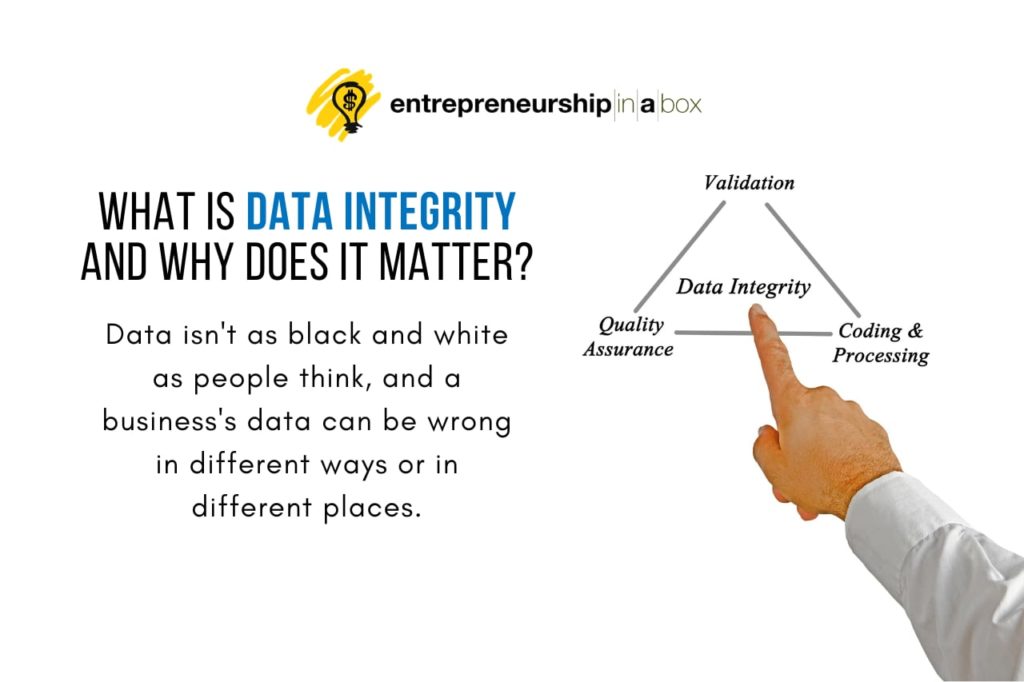
It is, in the easiest terms possible, the correctness of your data. Believe it or not, data isn’t as black and white as people think, and a business’s data can be wrong in different ways or in different places.

There are actually different kinds of data integrity issues. There are physical issues that deal with the accuracy of data as it is being stored or pulled. Even though it’s considered a physical issue, this can be digital data storage.

For example, if you have a system that can only keep two decimal places, and your data has six places after the decimal, then there’s potential for things to go wrong. 

Data integrity refers to the accuracy, completeness, consistency, accessibility, validity, and security of your business data throughout its lifecycle. It is a critical aspect of data management that ensures the reliability and trustworthiness of data.

Data Integrity

When we talk about data integrity, we’re talking about the assurance that the data you rely on is both accurate and reliable. This is essential for making informed decisions, as it ensures that the data-driven insights you derive are based on high-quality data.

Moreover, maintaining data integrity is crucial for the security and confidentiality of sensitive data, as it prevents unauthorized alterations and ensures that data remains consistent over time.

In essence, data integrity is a cornerstone of effective data governance and a key factor in maintaining overall data quality.

Data Integrity vs. Data Quality: How Are They Different?

Data integrity and data quality are closely related concepts, but both serve different purposes in the domain of data management. So, understanding their differences is essential for you if you want to maintain high-quality data and ensure its reliability.

As we already explained above, data integrity refers to the accuracy, consistency, and reliability of data throughout its lifecycle. It ensures that data remains unchanged and trustworthy, preventing unauthorized access or modifications.

So, data integrity requires a focus on maintaining the data’s integrity from creation to use of the data by implementing rules and restrictions that will protect them against corruption or loss.

Data quality, on the other hand, pertains to the overall condition of the data, measuring factors like accuracy, completeness, consistency, uniqueness, timeliness, and relevance. It is the measure of data integrity or whether the data is fit for its intended use and meets the organization’s standards and requirements.

Simply, data quality involves assessing data’s usefulness, accuracy, and timeliness to ensure it supports effective decision-making.

Let’s look at some examples.

Consider a supply chain management system. Data integrity ensures that inventory records are consistently maintained without unauthorized alterations. On the other side, data quality ensures that the inventory data is accurate, complete, and timely, allowing for efficient supply chain operations.

Data Integrity and Data Security Are Different

Some people often use data integrity vs data security and data quality interchangeably, but they are not the same. Data integrity is strictly about the accuracy and completeness of the data, which can result in security problems, but it’s not data security.

Data security is about how safeguarded your data is, and paying attention to the two together is important. Keeping your data correct and safe goes hand in hand.

Types of Data Integrity

Types of Data Integrity

There are two main types of data integrity to ensure integrity in both hierarchical and relational databases, each playing a unique role in ensuring that your data remains accurate and reliable:

Physical Integrity

This type of integrity focuses on protecting data from physical damage, corruption, or loss that directly will impact the overall data quality.

Physical integrity involves ensuring that data is stored and retrieved correctly, safeguarding it from threats like power outages, natural disasters, and hardware failures.

Think of physical integrity as the physical security measures you take to protect your data.

Logical Integrity

Logical integrity, on the other hand, ensures data correctness and consistency within a specific context. It involves making sure that data is accurate, complete, and consistent, adhering to specific rules and constraints.

This type of integrity is crucial for maintaining the logical structure and relationships within your data.

There are several types of logical integrity of the data quality:

Domain Integrity

Domain integrity refers to the acceptable range of values (domain) for a particular column in a database. Simply, this integrity defines a set of acceptable values.

As you can see, domain integrity ensures that data conforms to specific formats and standards, preventing incorrect or incomplete data entries.

For example, a date field should only contain valid dates. Or the amount of sales in valid currency, etc.

Entity Integrity

Entity integrity, on the other hand, ensures the uniqueness of data entities within a database. It involves making sure that each entity has a unique identifier (primary keys) for particular points of data, preventing duplication and inconsistency of these data. In such a way, it will ensure data quality.

This is vital for maintaining the uniqueness and accuracy of records.

I had a really big problem when I was part of an acceptance team for a developed intelligence module in Customs Administration. As a lead of a team, I’ve found that for one entity, such as persons or vehicles, there was a possibility to enter different unique identifiers for the same entity without specific data quality measures that will prevent such data creation.

For example, the same person can be entered with two unique identifiers that are different. Then, when the people from the intelligence department use these data for analysis, the same person will be recognized as a different person. So, I don’t sign the acceptance.

Referential Integrity

Referential integrity focuses on the consistency of data relationships between tables in a database. Simply, here we talk about how they are stored (what tables) and how they are used.

This integrity ensures that data is consistent and accurate across related tables, maintaining the integrity of relationships within the database. In such a way, it can ensure the prevention of duplicated data, inaccuracy, or irrelevancy.

User-Defined Integrity

User-defined integrity applies specific rules and constraints defined by users to ensure data integrity. These are specific business rules and requirements that data must conform to, tailored to the unique needs of your organization.

Why is Data Integrity Important

Why is Data Integrity Important

Maintaining good data integrity offers numerous benefits that can significantly impact your business:

  1. Improved Decision-Making: When your data is accurate, complete, and consistent, you can make better-informed decisions. High-quality data provides a solid foundation for strategic planning and operational efficiency.
  2. Increased Trust: Reliable data builds trust within your organization and with external stakeholders. When everyone can depend on the data, it fosters confidence in data-driven processes and outcomes.
  3. Better Data Security: Ensuring data integrity also improves data security. By protecting sensitive data from unauthorized access, corruption, or loss, you safeguard your organization’s valuable information assets.
  4. Improved Data Quality: Good data integrity directly translates to improved data quality. Accurate, complete, and consistent data is essential for effective data analysis and reporting.
  5. Reduced Errors: High data integrity reduces errors and inconsistencies, saving time and resources. By minimizing data-related issues, you can focus on more strategic tasks and improve overall productivity.

Tools for Improving Data Integrity

There are several tools and techniques that can help you improve and maintain data integrity in your business:

Data Validation

This involves checking data for accuracy, completeness, and consistency. Validation rules can be applied at the point of data entry to ensure only good data is captured.

For example, you have a customer database where each entry requires a valid email address. In this case, you can apply data validation rules that will check if the email field has a properly formatted email address, e.g., “[email protected].”

data validation

If a user tries to enter an incorrect format like “example@domain” the system will flag the error and ask the user to correct it before submission.

This prevents bad data from getting into the database and, hence, data accuracy and reliability.

Data Normalization

Data normalization is a way to organize your data in a database. It means structuring a database so it reduces redundancy and dependency and stores data logically and consistently.

If we go back to our customer database example, without normalization, you would have a table with customer information repeated for each order they make. This leads to data anomalies and inconsistencies.

By normalizing, we can separate the customer information into a different table with a unique customer ID. This ID can then be referenced in the orders table, so customer details are only stored once. This reduces redundancy and keeps data integrity by keeping it consistent across the database.

Any change to a customer’s information only needs to be made once in the customer table, and it will automatically be reflected in all related records.

Data Standardization

Standardizing data into a specific format makes sense across different systems and datasets. Standardization is key to data integration and data sharing.

Let’s say you have customers’ data coming into your business database from various sources – online forms, call centers, and in-person. Each source may record the customer’s name differently – “John Doe,” “Doe, John,” or “J. Doe.” This inconsistency can lead to duplicate records and errors in the database.

To keep data integrity, you need to implement standardization processes that will allow a uniform format for recording customer names as “First Name Last Name” across all data entry points.

By standardizing data, you can reduce the risk of duplicate data, improve data accuracy and, therefore, more reliable decisions.

Other Tools

The previous three techniques are one of the most important when it comes to ensuring data integrity. However, you have other tools available to ensure better integrity of your business data.

Let’s look at them:

  1. Data backup and recovery means that you have copies of your data and a recovery plan in place that will protect you against data loss or corruption.
  2. Data encryption means protecting sensitive data from unauthorized access through encryption and ensures that only authorized users can view or modify the data.
  3. Data access control will restrict access to data to only authorized persons and, in such a way, helps you prevent unauthorized changes and maintain data security.
  4. Audit trails and logs mean tracking changes to data and monitoring data access through audit trails and logs to help you detect and address any integrity issues promptly.
  5. Error handling mechanisms implement specific mechanisms to detect and correct errors in data, ensuring that any issues are addressed quickly and maintaining data accuracy.
  6. Data governance means establishing policies and procedures for data management that ensure the integrity of the data through strong data governance practices, which is essential for long-term data quality and reliability.

How to Maintain Data Integrity

There are plenty of ways you can protect the integrity of your data. By implementing these tools and techniques we cover above, you can achieve and maintain high data integrity, ensuring that your data remains a valuable asset for your organization.

To achieve data integrity, it is crucial to implement necessary guidelines and rules that ensure the accuracy and reliability of data throughout its lifecycle.

Large companies that have the budget to do everything in-house typically choose to do just that. However, this doesn’t work for the majority of companies, especially small businesses, without enough resources to do that in-house.

Hiring someone to keep up with your data typically comes at a high cost. These workers generally have master’s degrees, and they expect to be paid well. You’ll also have to add them to a department or create a job space for them specifically, and neither of these options is doable for everyone.

Outsourcing these jobs is the better route for most companies. GlobalVision is a great company that can protect the integrity of your data for you, and it’s an easy group to work with. You can also get quality protection for your data as well.

Make Data Integrity Non-Negotiable

So, what is data integrity? You should now know what data integrity is and how it can affect your company. These issues can cause major problems in your company, including costly fines that can lead to your company going under.

Ensuring your data’s integrity is crucial for maintaining the consistency and accuracy of critical transaction details. Lesser issues look like bad results from marketing campaigns or even low customer satisfaction.

Don’t wait to make your data integrity a priority—start today.