When your customers stop buying from you, it’s the right time to start doing something. But, you don’t need to do something, only because you need to do something. You will need to find the real reasons and develop customer retention strategies. You can do this only if you base your decisions on data-driven techniques.
Do you have customer retention strategies? It is crucial for your company, especially when you want to bring back your previous results. The business world is not something that you can see as the continuous line. There will be many ups and downs that you will need to manage from your side.
Here, I want to share five things or action steps you need to take if you want to bring back your previous sales results.
1. Stop for a Moment and Start Analyzing Why Customers Stop Buying
With this step, you want to see if there are some internal factors why customers stop buying from you.
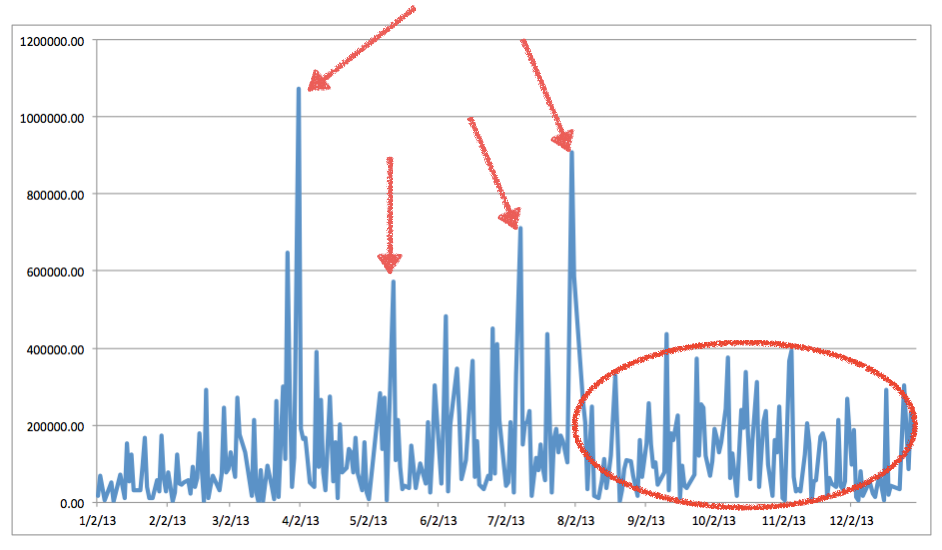
As a starting point when you find yourself in such a situation, the best thing is to look at your historical data. What does this mean? It means to look at your sales records in one more considerable period to find possible trends.
Look at your sales time series data and locate all positive or negative variations there. (See the photo below).
While you are looking at your data and trends, ask yourself the following questions:
- When have the numbers started varying? Is it positive or negative variation? When I have the most significant sales? Why I don’t have such numbers on a constant basis.
- What have I done in that specific period when numbers start climbing? You want to find the correlation between your activities and your sales numbers.
- Who are the customers who have the enormous difference in the quantity of their amount of orders? Why? Compare the customer’s behavior in good and bad times on your trend data.
Related: How to Develop and Improve Your B2B Sales Processes
2. Make an RFM analysis when customers stop buying
In the first step, you analyze your sales data and identify some possible reasons you have decreased sales. Now, you will also need to analyze the behavior of your customers.
The best tool for this purpose is RFM analysis. RFM analysis is a technique used to determine which customers are the best ones quantitatively. You can do this by just monitoring your customers:
- How recently a customer has purchased something from your business (recency),
- How often they buy from your company (frequency), and
- Or, how much the customer spends on your business (monetary).
With the help of this technique, you will classify each of your customers according to the RFM score. The RFM score will have three numbers. Each number explains where the specific customer is according to recency, frequency, and monetary value. (See the screenshot below).
Example of RFM Analysis
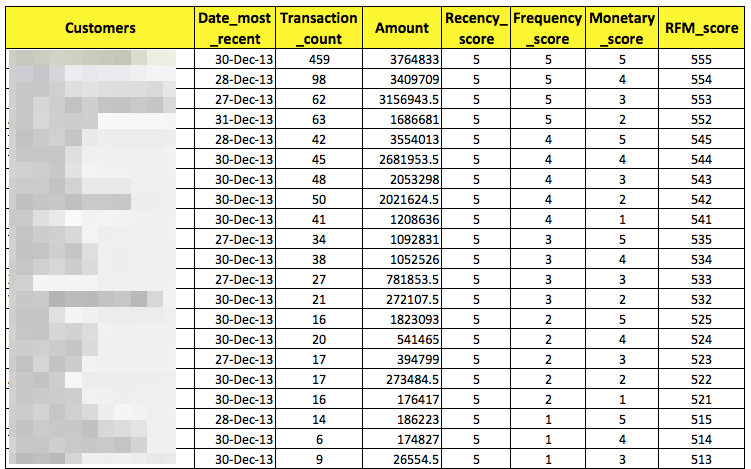
As you can see from this data, you will classify all your customers according to RFM scores. In this case, the best customers have 555 as the RFM score. This means 5 for recency, 5 for frequency, and 5 for monetary value.
The last customer presented with this data has a 513 RFM score. This means that this customer has recently bought something from you, but his buying frequency in the analyzed period is very low. Your goal will be to do something to increase the frequency score of this customer. You can also see that you have a space for improvements related to the amount of money this customer spends in your company. For example, you can try something with up-sells and cross-sells tactics.
So, after you finish with this analysis, open your customer database and contact all customers for whom you chose to improve your RFM score.
Related: 8 Ideas to Help You to Create Your Own Sales Leads Databases
3. Analyze Your Competitors When Your Customers Stop Buying From You
The third thing you will need to do is to analyze your competitors and their activities in the period when your sales start decreasing. Answer the following questions:
- What have they done in this specific period when your sales numbers start declining?
- Is there any correlation between their actions and your sales numbers?
- What will be your response?
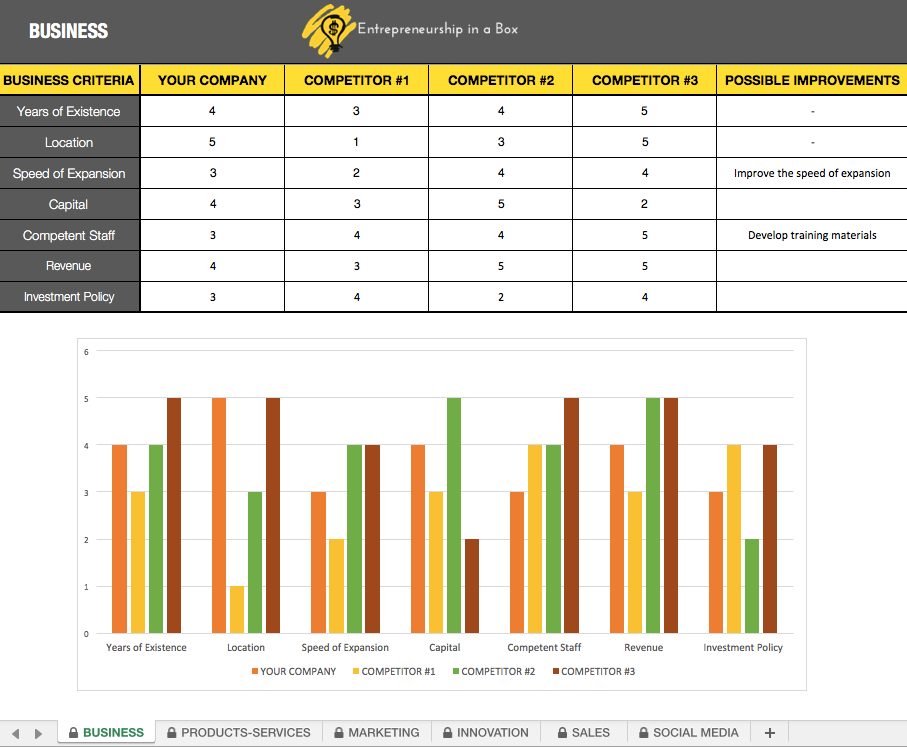
Many times there is a strong negative correlation between competitors’ behavior and your sales results. Because of that, you will need to analyze your competitors and compare your position with theirs. You can download this competitive analysis template to help you with these activities.
4. Is What You Are Selling Still Valuable To Your Customers?
Is the value you are offering still attractive to your customers? Suppose you don’t have continuous innovation activities that will include developing new products and services or improving existing ones. In that case, you can find yourself in a situation where your offer will lose value in customers’ eyes.
It is crucial for you consistently to deliver the highest possible value for your customers. Your job as an entrepreneur is to:
Know your customers’ perspectives.
You can not add value without seeing your business through the eyes of your customers. What is essential to your target customers, and how will your products benefit your customers? What problems do your products solve for them? Are these issues still active for your target customers? Do your products still help them overcome obstacles or do their jobs better?
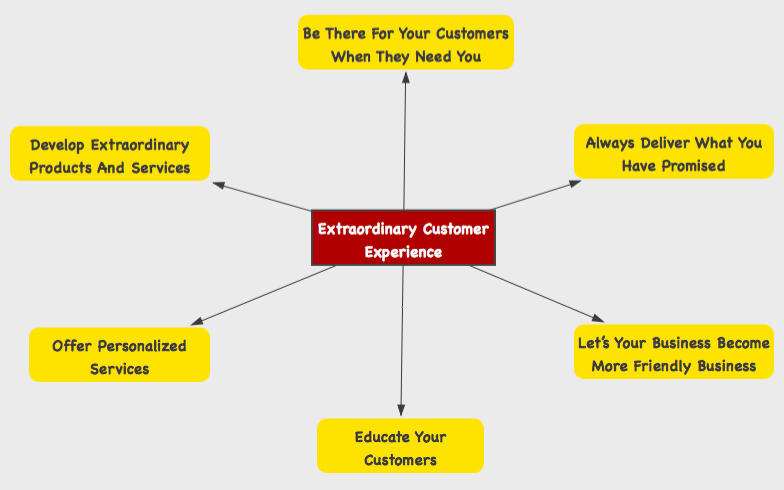
Deliver extraordinary customer experience.
You will need to deliver an extraordinary customer experience from initial lead capture to post-sale communication. Additionally, put all your efforts into making the continuous maximization of value delivered to the customer throughout these processes in your business. Learn how you can create standard operating procedures to improve your business processes. If you build an extraordinary customer experience, you will develop relationships with your customers. In such a way, you can connect with them at much higher levels, delivering exceptional intangible value that cannot be packaged or sold.
Consistently work to improve customer satisfaction.
Probably you already know that lack of customer satisfaction is a sure way to keep people from coming back to your company. Get feedback through surveys regularly from your customers and talk with them regularly.
5. Is The Price You Charge Still Right for Your Customers
Your price must reflect the value that you offer to your customers. Selecting and implementing pricing strategies can be the catchy thing for many entrepreneurs.
Until now, you have analyzed your customers and competition. You improve the value that you are offering to your customers. So, you know what your customers want, what is the competitor’s price. You also know how much they can pay for the solution to their problems and how much is worth your offer. Now, you will need to balance all these things. Ensure that the price of your products and services is still suitable for your customers.
If you conclude that they are not correct, it is time to think about the change of your pricing strategy.
Actions to Take When Your Customers Stop Buying
- Analyze your sales data and learn from trends.
- Make RFM analysis.
- Create a strategy to improve RFM scores on all essential customers for your business.
- Start with the implementation of the strategy for RFM score improvement.
- Analyze your competitors. Check if there is a possible correlation between their actions and your sales results and negative sales trends.
- Check the value you are offering to your customers. Is it still valuable?
- Install continuous improvement process to ensure permanent value adding to your offer.
- Check your pricing strategy. If you need to do something related to your pricing strategy, change it.
That’s all, folks! Have luck in retaining your customers.