I have spoken extensively about the concept of business potential energy. It is a cornerstone of the work I do. It is a proven technique I utilize in my consulting practice to help clients not just improve, but improve with exponential speed.
But let’s be honest for a second. We have all experienced a specific kind of business heartbreak. You know the one I’m talking about. You look at a business—maybe it’s yours, maybe it’s a client’s—and on paper, it looks incredible. It has “potential.” The ideas are sharp, the resources are there, the market seems ready.
And yet… nothing happens. The business stalls. It feels like you are pushing a boulder uphill.
Why does this happen? Why do some companies with average resources skyrocket, while “perfect” companies stagnate?
To answer that, we have to stop thinking like accountants and start thinking like physicists.
We have to look at the transition from Potential to Kinetic energy.
You can also read my articles about business potential energy here:
- The Physics of Entrepreneurship: Why You Must Build Potential Before You Can Create Motion
- Business Potential Energy: The Hidden Metric Determining Your Success
- The Formula for Winning: How to Calculate the Business Potential Energy of Your Ideas
The Myth of Linearity
Let’s start by defining what we are actually talking about. What is Business Performance?
Most people think performance is simply looking at a spreadsheet at the end of the month to check the bottom line. But that is looking in the rearview mirror. That is an autopsy, not a diagnosis.
In my view, performance is the possibility of an individual or a group to accomplish desired targets.
- Performance is a measure of results achieved.
- Business Performance is the possibility for the business to achieve the goals you set.
If your business achieves great results, you have high performance. If you achieve small results (or nothing), you have small performance. Simple, right?
But here is the trap. The common trap entrepreneurs fall into is thinking this relationship is strictly linear.
They believe in a simple input/output equation:
- High levels of Business Potential Energy = Better Business Performance.
- Low levels of Business Potential Energy = Smaller Business Performance.

This sounds logical. It comforts us because it suggests that if we just “add more” (more money, more staff, more ideas), we will get more out.
It is not enough to be busy. So are the ants. The question is: What are we busy about?
Henry David Thoreau
But it is incomplete.
If this were always true, every startup with a “good idea” (potential) and a pile of VC cash would be a massive success.
We know that isn’t the case. History is littered with well-funded companies that had massive potential but zero performance.
The Missing Link: Kinetic Energy
So, if potential isn’t enough, what is missing?
Here is the missing transformation: Kinetic Energy.
In physics, potential energy is stored energy. It sits there, waiting. A rock sitting at the top of a hill has high potential energy, but as long as it sits there, it does no work. It has zero impact on the world. It does nothing until it is transformed into motion—kinetic energy.
The same applies to your company.
Ideas are cheap. Ideas are easy. Ideas are common. Everybody has ideas. Ideas are highly, highly overvalued. Execution is all that matters.
Casey Neistat
Your business plan, your talented team, your patents—these are all potential energy. But without the kinetic energy with which your business performs actual work, you cannot expect your business performance to increase.
Because of this, we cannot take the linearity of business performance to be totally true. We need a formula that accounts for execution. We need a way to measure the friction between your great ideas and the reality of the market.
The Formula for Exponential Growth
If we assume that potential energy influences performance, we need to identify the specific factors at play.
We need to stop guessing and start calculating.
Through my analysis, there are three factors that determine your success:
- Business Potential Energy (BPE): The stored value/charge of your business. This is the quality of your core business model.
- Crucial Business Elements (N): The number of elements (resources, operations, products, employees) that possess this potential. This is your leverage.
- Possibility of Transformation (P): The likelihood of converting that potential into kinetic energy. This is your execution capability.
When we combine these, we find that the dependence is not linear—it is an exponential function. As one element grows, the whole function grows explosively.
The formula for your Business Performance is:

Where:
- BP is Business Performance.
- P is the possibility to transform your potential into kinetic energy (Likelihood 0 is less than or equal to P is less than or equal to 1).
- N is the number of crucial business elements you have selected to increase (N > 0).
- BPE is the value of your Business Potential Energy (0 is less than or equal to BPE is less than or equal to 1).

Analyzing the Variables
This formula gives you a dashboard to cover all crucial factors influencing your performance. But let’s look closer, because the magic is in the math.
Notice the position of BPE in the formula. It acts as a multiplier, but more importantly, it acts as an exponent (N^BPE).
This is the critical insight that separates linear businesses from exponential ones.
When you increase your Business Potential Energy, you aren’t just adding to your results; you are raising the power of your organization. You are achieving an exponential increase in how your crucial elements (N) perform.
However, you must pay attention to the constraints:
- The BPE value ranges from 0 to 1. Think of this as a percentage of quality. A generic, flawed business model might be a 0.1. A disruptive, perfectly fit model is a 1.0.
- The P (Transformation/Kinetic possibility) ranges from 0 to 1. If your team is lazy or your systems are broken, P approaches 0. If you are a well-oiled machine, P approaches 1.
- N must be a positive number greater than 0. You need something to work with.
The “Zero” Danger: A Scenario Analysis
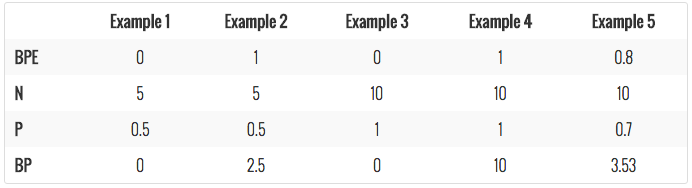
Theory is great, but let’s look at the numbers. Let’s look at some examples to see how this plays out in the real world.
This clearly demonstrates why some businesses fail despite having resources, and why others succeed wildly.
| Scenario | BPE (Potential) | N (Elements) | P (Kinetic Execution) | BP (Result) |
| #1 | 0 | 5 | 0.5 | 0 |
| #2 | 1 | 5 | 0.5 | 2.5 |
| #3 | 0 | 10 | 1.0 | 0 |
| #4 | 1 | 10 | 1.0 | 10 |
| #5 | 0.8 | 10 | 0.7 | 3.53 |
The Lesson of the Extremes:
I want you to look closely at Example #3. This is the scenario that breaks the hearts of most entrepreneurs.
In Example #3, you have a massive amount of resources (N=10). Maybe you hired the best staff, bought the best software, and rented a fancy office. You also have perfect execution (P=1). Your team is working 12 hours a day, hitting every deadline, and following every process.
But, your Business Potential Energy is 0. Maybe the product solves a problem nobody has. Maybe the market has moved on.
The result? Zero performance.
Efficiency is doing things right; effectiveness is doing the right things.
Peter Drucker
This proves that if your core potential energy is zero, it does not matter how good your other elements are. You cannot execute on a vacuum. You cannot multiply zero and expect a result. This is why “working hard” is not a strategy.

Now look at Example #1. Even with average resources (N=5) and average effort (P=0.5), if the potential is zero, the result is still zero.
The Lesson of Maximums:
Now look at Example #4. This is where we all want to be.
Here, the Potential Energy is at a maximum level (1.00). The business idea is sound, the market fit is perfect, and the value proposition is irresistible. Because of this, the business creates an environment where it can fully utilize the potential of the other elements.
The performance skyrockets to 10.
But notice Example #5. This is the “Real World” scenario.
- You have great resources (N=10).
- You have a very good business model (BPE=0.8).
- You have decent execution (P=0.7).
- The result is 3.53.
Wait, only 3.53? Yes. Because BPE is an exponent, a small drop in potential energy (from 1.0 to 0.8) and a small drop in execution (from 1.0 to 0.7) drastically reduces your output.
This shows us that “good enough” is the enemy of exponential growth.
Strategic Application: How to Hack the Variables
So, what do you do with this information? You don’t just hang the formula on your wall. You use it to audit your business.
If your business feels stuck, one of these three variables is the bottleneck.
1. Auditing Your Potential (BPE)
Ask yourself: Is the core energy of this business actually charged?
If your BPE is low, adding more employees (N) is a waste of money. You need to fix the core.
Action: Innovation, market research, and refining your unique value proposition increase BPE. You need to move from “selling a commodity” (low BPE) to “solving a painful problem uniquely” (high BPE).
2. Auditing Your Transformation (P)
Ask yourself: How much friction is in our system?
If you have a great idea (High BPE) and lots of staff (High N), but you’re still failing, your P is likely low.
Action: Here, operations management comes in. Streamline processes, improve leadership communication, and remove bureaucratic hurdles. Every obstacle you remove will increase P, which allows the potential to flow into kinetic results.
Simplicity is the ultimate sophistication.
Leonardo da Vinci
3. Auditing Your Elements (N)
Ask yourself: Do we have enough leverage?
If your BPE is 1.0 and your P is 1.0, but you are a solopreneur with no capital, your N is 1. Your result will be limited.
Action: This is the scaling phase. Once BPE and P are optimized, you pour fuel on the fire. You hire, you automate, you expand marketing channels.
Summary
You can achieve exponential increases in your business performance, but only if you respect the physics of the formula.
You must increase your number of crucial elements (N), you must ensure you have high probabilities of transforming that energy into action (P), but above all, you must ensure your Business Potential Energy (BPE) is not sitting at zero.
If BPE is zero, you are multiplying by zero.
If BPE is one, you are unlocking the exponential power of your organization. When you get the potential right, the kinetic execution follows, and the results become not just better, but exponential.