Organizational changes are most important part of every business, and they have constant flow. This means that business doesn’t have time without the implementation of any types of change. However, every change is followed with some type of resistance to that change. The reasons of resistance to change can be different. I’ve already written about my research that finds 28 factors that cause resistance to organizational change.
Here I want to mention these four facts about resistance to change:
1) IF Organizational changes IS Constant, THEN Resistance to Change IS Constant
This is simple if-then rule. If we agree that changes are something that never stops in business life and every change is followed by some type of resistance, then also resistance will never stop in the business life. Somewhere I have read that one of the biggest tasks of managers is to implement change and deal with resistance of that change.
2) Resistance = Damage, But Also Resistance = Benefit That Can Help for Better Changes
Yes, resistance to change can produce big damage to the change process or implementation of the change process. The results from change will be new tasks, new procedures or simply new ways of doing the things in the company. Those things must be performed by employees, and if they resist to that change, they will never change their previous behaviors and ways of doing the things.
However, on the other hand, we cannot be sure that the planning process is always performed perfectly. Sometimes every individual in the business can bring perfect ideas about improvements. These individuals resist because they found something that can be improved in the change process. This resistance can be beneficial to the change process.
3) IF Resistance is Damage, THEN You Must Overcome It
Probably you don’t want damage in your change process. Because of that, you must find ways how to overcome this resistance to change before you start with the implementation process. Sometimes resistance to change can cause huge consequences that mean stopping the whole process and you will fail.
4) IF Resistance is Benefit, THEN It Must to Be Used to Improve the Change Process
Sometimes people who resist the change have discovered weaknesses in the process of organizational change. This type of resistance is beneficial because these weaknesses can be eliminated before you start with the process of change.
The Level of Resistance to Change
Some important thing when we talk about resistance to changes is the level of resistance. The level of resistance can be:
- Small resistance. There is little resistance to proposed changes that can be easily overcome. The change process has possibilities to be successful without some big interventions from the managers or entrepreneurs.
- Medium resistance. There is medium resistance to proposed changes. Implementation of the change process will be successful if entrepreneurs or managers eliminate the weakness of the proposed change process that was discovered from some type of resistance.
- Big resistance. There is big resistance to proposed changes and probably change implementation process will not success.
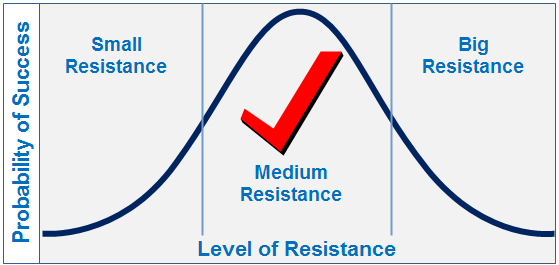
As you can see from the picture above, if the level of resistance is small there is a probability that the change process will not give the desired level of success. This situation can have two cases:
- There is no resistance because the employees are not interested in a change process.
- There is no resistance before starting the change process, but after that it will be.
Another part of the pictures is medium resistance to change that give us the biggest probability of success. In this situation, we have resistance to change that will improve the process of change. Here we have also two cases:
- We have resistance that we can simply overcome it.
- We have resistance because people find some weakness of the proposed change process, and we can solve that weakness before we start with the change process.
And the last part of the picture is a big level of resistance to change. This type of the resistance can bring the unsuccessful change process. So, it is better to stop here and repeat the whole planning process. Here are also several cases that impact on the process:
- We have resistance that we can simply overcome it.
- We have resistance because people find some weakness of the proposed change process, and we can solve that weakness before starting with the change process.
- At the same time, we have resistance from the powerful people in the business that we cannot simply overcome it.