The “Devilment” Trap: How to Maintain High Performance at All Stages of the Business Life Cycle

Devilment Trap - How to Maintain High Performance

In my previous writings about the concept of business potential energy, I made a crucial point that many entrepreneurs miss entirely: if you want to sustainably improve your business, your methodology must factor in the business life cycle.

Why is this so profoundly important?

Because a business is not a static object. It is a living, breathing, and constantly evolving organism. We are constantly dealing with different business elements—like sales, management, operations, and finances—that hold entirely different levels of “potential energy” depending on the exact stage of life your business is currently navigating.

Think of potential energy like a coiled spring or a fully charged battery. You spend time packing energy into that spring, and eventually, you release it as kinetic energy (which, in the business world, translates to your actual, measurable performance).

If you try to force performance when the battery is dead, you burn out. If you charge the battery but never release the spring, you stagnate.

If you want to maintain high performance over the long haul, you need to deeply understand the profound correlation between these life cycle stages, your stored business potential energy, and your actual daily performance.

Let’s dive into exactly how this works, where the hidden traps lie, and how you can architect your business to win at every single stage.

The Link Between Business Potential Energy and Performance

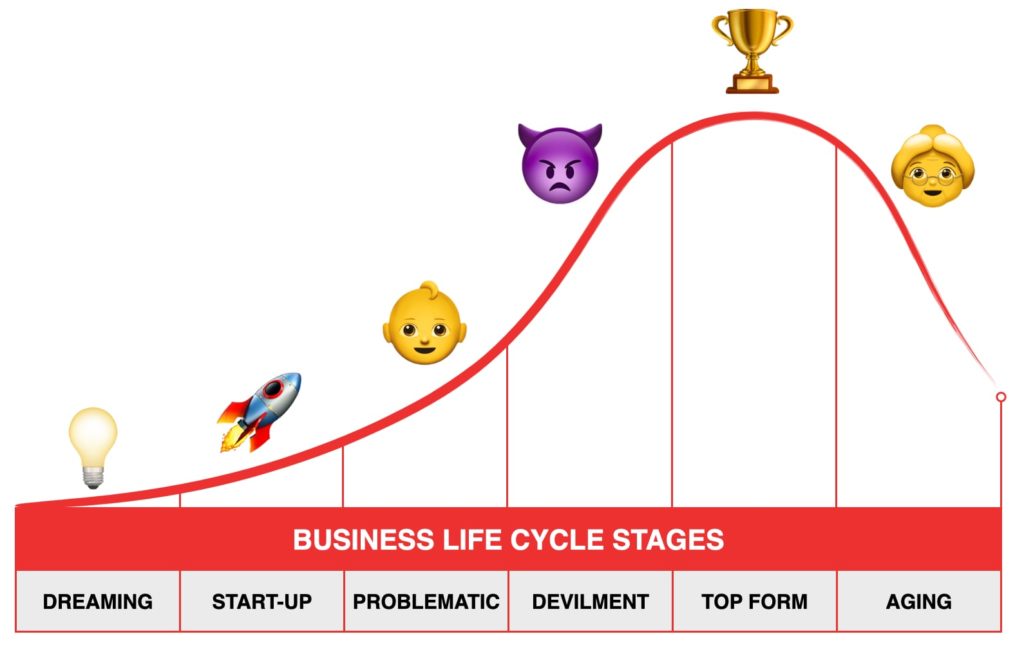
To understand this dynamic, let’s look at the standard arc of business performance over time.

Business Life Cycle Stages

As you can see on the graph, at the very beginning of the journey, actual business performance is at its absolute lowest level. You have no customers, no revenue, and no market share. But, as the company pushes through the various business life cycles, performance steadily increases.

However, there is a massive catch that catches even the smartest founders off guard: when a business eventually enters the “aging” level, performance takes a steep nosedive. The momentum stalls. The energy dissipates.

So, how do we keep that performance consistently high and stop the inevitable decline?

The secret isn’t just working harder; it’s working smarter by aligning your strategy with your current stage.

Navigating the 6 Stages of the Business Life Cycle

Let’s break down exactly what is happening to your business potential energy in all six stages. More importantly, we are going to look at the strategic, actionable steps you must take to maintain top performance in each one.

Stage 1: The Dreaming Phase (Ideation & Validation)

Every great company starts as a simple thought. I call this the “Dreaming” stage because right now, you are literally just dreaming about what could be. You are sitting at a coffee shop, scribbling on napkins, and looking at the world through a lens of pure possibility.

At this point, you don’t have complex business elements like sales teams, HR departments, or management structures to worry about. Here, the only business element that holds any potential energy is your business idea itself.

The Biggest Mistake at Stage 1

The biggest mistake entrepreneurs make here is falling in love with their very first idea. They lock onto a concept and let their ego drive the ship, refusing to look at market realities.

But remember, the potential energy of your entire future business is determined by the quality and viability of this initial spark. If the idea is fundamentally flawed, you are packing your battery with sand instead of electricity.

What You Should Do in The Dreaming Phase?

  • Generate Volume: You will naturally develop several business ideas. Don’t just pick the first one. Brainstorm at least 10-15 variations of your concept.
  • Ruthless Validation: Analyze them rigorously. Talk to potential customers. Ask them what they hate about current solutions. If they aren’t excited about your proposed fix, scrap it and move to the next idea.
  • Create a Micro-Test: Before spending a dime on legal fees or inventory, build a simple landing page or offer a pre-sale. Prove that someone will actually pay for this.

The simple rule for this stage is: the better your validated business idea, the more business potential energy you will store up for the brutal road ahead.

Ideas are just a multiplier of execution.

Derek Sivers

Stage 2: The Startup Phase (Launch & Early Execution)

Once you’ve successfully selected your optimal idea and finished the Dreaming stage, you step into the arena. You move into the Startup stage. This is where the entrepreneur takes those critical first steps to legalize the business, set up the infrastructure, and bring the concept into the real world.

Here, you are actively transforming that stored potential energy from your business plan into a living, breathing, cash-generating operation.

The Revenue – The Only Important Thing in Stage 2

Many founders get stuck playing “business.”

They design beautiful logos, order expensive business cards, and spend weeks tweaking their website’s color palette. This is a massive waste of potential energy.

In the Startup phase, the only thing that proves your business is real is revenue.

What You Should Do in The Startup Stage?

  • Shift to Pure Execution: You must shift your focus entirely from planning to doing. Now that the business is real, new crucial elements enter the picture.
  • Obsess Over Sales and Cash Flow: To keep your momentum high, you must fiercely prioritize early selling and finances. Without focusing on these two elements immediately, that initial potential energy will quickly fizzle out. Cash is the oxygen your new business needs to survive.
  • Launch the Minimum Viable Product (MVP): Stop trying to be perfect. Get a “good enough” version of your product or service into the hands of real customers immediately so you can start collecting feedback and cash.

Stage 3: The Reality Check (Overcoming Early Struggles)

Everyone has a plan until they get punched in the mouth.

Mike Tyson

In many cases, this is where an entrepreneur’s morale takes a massive, sobering hit. You suddenly realize the sheer, overwhelming complexity of running and managing your own company. You are wearing a dozen hats, and none of them seem to fit quite right.

I used to call this the “Problematic Period,” and for good reason. This is when the initial honeymoon ends and the first real, structural problems strike: a sudden lack of finances, surprisingly low sales levels, and operational costs that are much higher than your optimistic spreadsheet anticipated.

The Strategic Deep Dive of Stage 3

This stage is the great filter of entrepreneurship. It separates the hobbyists from the true business builders.

The energy drain here is immense because you are constantly putting out fires instead of building the house. The mistake here is trying to outwork the chaos through sheer willpower.

Remember that willpower depletes; systems do not.

How to Overcome Early Struggles

  • Make Hard Decisions Fast: This stage requires real, hard decisions from you. You cannot just dream anymore. If a product line is bleeding money, cut it. If a marketing channel isn’t working, kill it.
  • Plug the Energy Leaks: To push through, you have to actively manage the business elements that are draining your energy. You must double down on your most effective marketing, ruthlessly refine your product quality, and start actively training your sales team to convert at a higher rate.
  • Build Basic Systems: Stop doing everything manually. Implement a basic CRM. Automate your invoicing. Surviving this reality check requires you to transition from “doing everything” to “building the machine that does the work.” That is the only way to reach the next level of growth.

Stage 4: Rapid Growth & The “Devilment” Trap

If your business survives the harsh reality check of the previous stage, you will enter a phase of rapid, intoxicating growth. You start feeling that your finances are finally stable, your team is executing, and your sales numbers are continuously rising month over month.

But beware: this introduces the most highly dangerous phase of the entire lifecycle. I call this the Devilment Stage.

The Devilment Trap

The "Devilment" Divergence in Stage 4 of Business Life Cycle

Why “Devilment”?

Because the sudden flow of money and success acts like a dangerous drug. After years of struggling, there is a massive risk of “wild behavior” from the entrepreneur. You feel invincible. You feel like everything you touch turns to gold.

Success is a lousy teacher. It seduces smart people into thinking they can’t lose.

Bill Gates

This behavior is characterized by the uncontrolled spending of money on completely unnecessary things and ego-driven investments. You lease a massive, flashy office space you don’t need. You hire bloated middle management because it makes you feel like a “real CEO.”

Also, you start investing your core business profits into unrelated side-hustles or crypto because you are bored with your core offering. You take your eye off the ball.

What You Should Do Regarding The Devilment Trap?

  • Acknowledge the Trap: If this reckless spending continues, your business will instantly lose its stored energy. Your runway will vanish, and you will fall right back into the previous problematic stage—only this time, with higher overhead and a bloated payroll.
  • Implement Iron-Clad Controls: To maintain high performance, you must put strict controls on the most crucial business elements of this phase: management, development, and planning.
  • Data Over Ego: Let your management structures and your CFO guide your finances, not your impulses. Every new hire and every new expansion must be backed by a clear, undeniable ROI (Return on Investment). Lock away a significant portion of your profits into a cash reserve for the inevitable rainy day.

Stage 5: Peak Performance (Sustaining “Top Form”)

When an entrepreneur successfully suppresses that wild “devilment” behavior and scales responsibly, they guide their company into Top Form.

At this stage, your income and sales numbers are at the highest possible level. Your management and sales teams are fully formed, autonomous, and operating like a well-oiled machine. Your brand is recognized in your market.

Everything works perfectly. You have finally “made it.”

The Strategic Top Form

This sounds like the finish line, but it is actually the edge of a cliff. Success breeds complacency.

When everything is going great, the urgency to innovate disappears. This is the “Innovator’s Dilemma.”

Companies in Top Form often get disrupted by hungry Stage 2 startups because the Top Form company is too busy protecting its current profits to invent the future.

What You Should Do Regarding Sustaining Top Form?

  • Maintain Productive Paranoia: Enjoy the success, but remain incredibly vigilant. This is a very dangerous situation because a business in Top Form is always at risk of sliding into one of two terrible directions. If you get too comfortable, you might slip backwards into the uncontrolled spending of the Devilment stage.
  • Fund the Future: Or worse, if you stop innovating entirely, you will push the business straight into the final stage: Aging. To prevent this, dedicate 10% to 20% of your resources to “Horizon 3” ideas—radical innovations, new product lines, or entirely new markets.
  • Empower Intrapreneurs: Give your best team members the budget and autonomy to build startups inside your existing company. Let them use your massive stored potential energy to create the next big thing before your competitors do.

Stage 6: The Aging Phase (Decline or Renewal?)

The Top Form Cliff (The S-Curve)

If you fail to innovate during Top Form, you arrive here. This is the dreaded Aging stage, where all things start moving backward at a decreasing rate.

Revenues plateau and then begin to slip. Key employees leave for more exciting opportunities. The market moves on to newer technologies, and your once-revolutionary product is now a commodity.

The entrepreneur and the business simply don’t have enough energy left to return things to the right path naturally. Business performance goes down heavily.

The Strategic Look at the Aging Phase

The organization has become heavy, bureaucratic, and slow. The original potential energy is entirely depleted.

Incremental tweaks—like a new marketing campaign or a minor pricing adjustment—will not save you here. The disease is structural, and therefore, the cure must be structural.

What You Should Do in the Aging Phase?

It is not necessary to change. Survival is not mandatory.

W. Edwards Deming
  • Embrace Radical Disruption: You cannot just wait it out, hoping the market will magically return to you. This stage requires bold, massive organizational changes.
  • Restructure and Rebuild: Structural changes are the only thing that can bring fresh energy back into a dying business. This might mean firing your legacy management team, cannibalizing your own core product with a cheaper digital alternative, or completely pivoting your target demographic.
  • Recharge the Battery: By implementing these drastic changes, you effectively act as a defibrillator to the company. You recharge the required business potential energy that was exhausted over the years, breathing new life and startup-level agility back into your most important business elements. You essentially force the company back into Stage 1, but this time, with the capital and wisdom of a veteran.

Conclusion: The Lifecycle is a Loop, Not a Line

Maintaining high performance isn’t about finding a magic bullet that makes the business easy forever. It is about deep self-awareness. It is about looking at your company with brutal honesty, identifying exactly which of the 6 stages you are currently in, and adapting your leadership style to match.

You must build the potential energy in the Dreaming phase, execute relentlessly in the Startup phase, build resilient systems during the Reality Check, suppress your ego during the Devilment phase, innovate endlessly in Top Form, and be willing to burn the ships and restructure during the Aging phase.

Business is a constant loop of generating, storing, and deploying energy. Master this flow, and you will build a company that doesn’t just survive the test of time—it dominates it.