3 Attractive Things You Actually Must Have In Your Awesome Business Ideas

Attractive Business Ideas

Business ideas are the starting point of every journey in entrepreneurship. They are the DNA of your future operations. Your validated business idea will effectively dictate the success—or the frustrating stagnation—of your small business for years to come.

But often, we overcomplicate what an idea actually is. We treat it like a mystical lightning strike or a stroke of genius that only hits the chosen few. This mindset is dangerous because it keeps you waiting for magic instead of building value.

If we want to describe the true meaning of a business idea, we can simply say this: A business idea is a solution to a problem that exists on the market.

That’s it. It’s not magic; it’s a solution.

Fall in love with the problem, not the solution.

Uri Levine (Co-founder of Waze)

Because of that definition, we can strip away the fluff. We can ignore the “cool factor” or the hype and focus on the mechanics of value.

Through my years of analyzing successful (and failed) startups, I’ve found that the most “awesome” business ideas actually must possess three specific elements to survive.

If you are missing just one, the stool falls over.

These three non-negotiable pillars are:

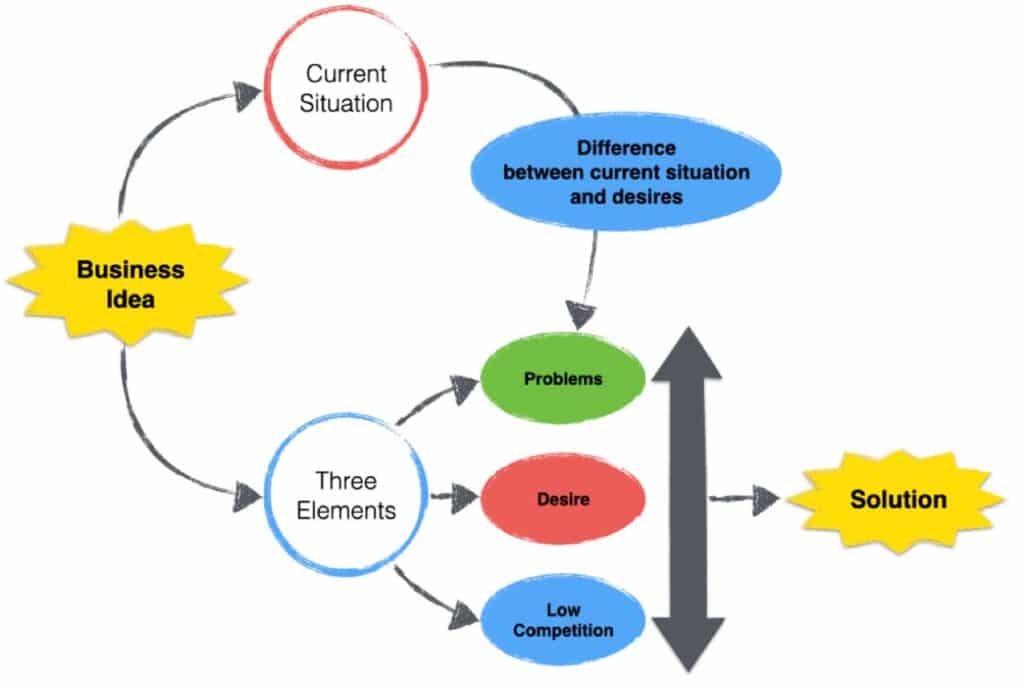
  1. A Problem (The Logic).
  2. A Desire (The Emotion).
  3. A Small Chance of Resolution (The Market Void).

Let’s break down why these three specific pillars are the difference between a hobby and a high-growth business.

Pillar 1: The Reality Gap (The Problem)

The first thing your business idea needs to include is the problem that its implementation will solve. This sounds obvious, doesn’t it? Yet, you would be shocked at how many entrepreneurs fall in love with their product before they have verified the problem.

business ideas three things

You have to ask yourself: Who will buy something from you if they don’t have a problem that gets solved by that purchase?

To truly understand this, we need to look at the anatomy of a problem.

A problem is an issue or obstacle that makes it difficult to achieve a specific desired goal, objective, or purpose. It refers to a situation, condition, or issue that is yet unresolved.

In a broad sense, a problem exists when an individual becomes aware of a significant difference between what actually is and what is desired.

This definition gives us the secret to our validation. People always desire something new or better than what is now. Between that desire and a current situation lies a gap. That gap is the problem.

Think of it like this:

  • Current State: My current process requires two days from start to finish.
  • Desired State: I want to finish it in one day.
  • The Gap: That one day of frustration.
  • The Business Idea: A tool that will short execution time for that specific process.

Every problem needs a solution, and those solutions are your business ideas.

The “Gap” Rule of Thumb

Here is the metric you need to watch: The bigger the difference between the current situation and the desire, the bigger the problem.

If the gap is small (e.g., “I wish my coffee was 5% hotter”), the problem is trivial.

But if the gap is massive (e.g., “I am losing $1,000 a day because of this software glitch”), you have a high-value opportunity.

With a bigger problem, you produce a bigger desire for the solution.

Problems will always exist in the market. As organizational expert Ichak Adizes says, we always have problems, and we will not have problems only when we die. However, not every problem carries the same weight.

If I had an hour to solve a problem I’d spend 55 minutes thinking about the problem and 5 minutes thinking about solutions.

Albert Einstein

Strategic Analysis: Finding the Right Problem

To find the real problem in the market—the one worth solving—you must analyze the current situation. Don’t just guess; go out and verify. You must ask and answer these critical questions:

  • What are the specific types of problems that exist in the market right now? Are they financial, emotional, or logistical?
  • How many people actually have this same problem? Is this a problem for three people in your neighborhood, or three million people online?
  • What are the potential solutions currently available? (And why do they suck?)
  • Can we offer the best solution for those problems? “Best” doesn’t mean perfect; it means better than the status quo.
  • Do those solutions solve the whole problem, or just a part of it? A partial solution often creates new problems. Aim for a complete resolution.

Pillar 2: The “Starving Crowd” (The Desire)

Having a problem (Pillar 1) provides the logic for your business. But logic alone rarely pulls the credit card out of the wallet. For that, you need emotion.

Some problems are big, and some are small. Some problems can be ignored by customers for years (like a messy garage), and some simply cannot (like a burst pipe). As an entrepreneur, you need to identify the problems where there is a big desire for a resolution.

Why is there a need for such a big desire?

Because if your potential customers are starving for the solutions that your business will give them, there is a significantly higher probability of success for your unique business idea.

The Psychology of “Wanting”

Desire is the emotional state of a person that represents the level of “wanting.” In your case, it is the level of wanting to find a solution.

Think about the difference between selling vitamins vs. selling painkillers.

  • Vitamins: You know you should take them. It’s logical. But if you forget for a week, nothing happens. The desire is low.
  • Painkillers: If you have a migraine, you aren’t debating the price. You aren’t shopping around. You need it now. The desire is immediate and overwhelming.

Logic might identify the problem, but emotion drives the purchase.

“People buy on emotion and justify on logic.”

Zig Ziglar

The more a person wants to fix the gap in their life, the bigger their desire will be. When they have a bigger desire, the decision to buy becomes automatic. They stop evaluating features and start focusing on relief.

The "Painkiller vs. Vitamin" Scale

Desire Drives Profitability

Desire is also crucial for your bottom line. If the desire is greater, the solution can be more expensive.

If I am selling a solution to a problem you barely care about, I have to compete on price. I have to be the cheapest. But if I am solving a problem you are desperate to fix, price becomes secondary. A strong desire brings more profit for your small business because the perceived value of the fix is higher to the customer.

How to Measure Market Hunger

You need to answer the following questions to see if your idea taps into a “starving crowd”:

  • What is the level of wanting to solve those problems? Is this a “top 3” priority for them today?
  • How big/painful is the problem your idea solves? Is it a “migraine” problem or a “vitamin” problem?
  • Are potential customers actually starving for a solution, or just mildly annoyed? Look for forums where people are complaining angrily. That is the sound of opportunity.
  • How are they seeking possible solutions? Are they hacking together their own bad solutions? That’s a great sign.

Pillar 3: The Market Void (Differentiation & Competition)

This third element is often overlooked, but it is critical. Your idea must address a problem where there is currently a small chance that the problem will be solved by existing offers.

This is all about market competition and the “void” in the current landscape.

If the market is already flooded with easy solutions, or if the customer can easily solve the problem themselves, your business idea loses value. However, if the market does not have big competition regarding that problem, or the current competition is doing a poor job, your chances of success skyrocket.

We call this the Solution Void. It’s the space where the customer says, “I have this problem, I want to fix it, but I literally cannot find a good way to do it.”

To validate this pillar, you must answer two hard questions:

1. How many competitors sell the same products in your target market?

If there are too many competitors doing exactly what you want to do, you are entering a bloody battle. This is often called a “Red Ocean”—red from the blood of competitors fighting for the same scrap of meat.

“Competition is for losers.”

Peter Thiel

You want to find a space where the problem is still “unresolved” despite the competition.

Strategic Tip: Don’t just look for direct competitors. Sometimes your biggest competitor is “Business as Usual.” If it’s easier for the customer to do nothing than to buy your product, you have a problem.

2. How can you take a position that differentiates you?

Differentiation is one of the most important things for every business. This is how your business looks in the eyes of customers.

Differentiation doesn’t mean being “better” in every way. It means being different in a way that matters to a specific group of people.

  • Can you be faster?
  • Can you be simpler?
  • Can you offer a guarantee that removes all risk?

If you can differentiate your business from the rest of the world—offering a solution that actually closes that gap we discussed in Pillar 1—then your business idea will become a success.

Differentiation (The Market Void)

The “Invention Trap”: Innovation vs. Execution

Before you rush off to the drawing board, I need to give you a final word of warning about a trap that kills many awesome business ideas before they are born.

You don’t need to invent something brand new to start a business.

Many entrepreneurs think they need to be the next Steve Jobs or Elon Musk. They think they need to invent a new technology or a product that the world has never seen. This is false.

If you are trying to find something exceptional, unique, or never-before-seen, maybe you will never find it. In such a way, you will stay at the “dreaming level” for your business forever.

Innovation isn’t just about the product. You can innovate on:

  • The Price Model: (e.g., Netflix shifted movies from rental fees to subscription).
  • The Delivery: (e.g., Domino’s didn’t invent pizza; they invented 30-minute delivery).
  • The Service: (e.g., Zappos didn’t invent shoes; they invented risk-free returns).

You don’t need to be an inventor; you need to be a problem solver who differentiates.

Related: Improve Productivity, Even if You Think That You Can’t

Your Next Steps: The Validation Checklist

Now that we have covered the theory, let’s make this practical. Don’t just close this tab. Take your current business idea—the one you are nurturing right now—and run it through this filter.

Does it have:

  1. A verified Gap? (Is the customer aware of the difference between where they are and where they want to be?)
  2. Emotional Heat? (Is the customer frustrated, angry, or desperate to close that gap?)
  3. A Market Void? (Are current solutions failing them, leaving an open lane for you?)

If you can answer “Yes” to all three, you have something powerful. You have the DNA of a successful business.

This post is an addition to our previous post about the three levels of the uniqueness of business ideas, where we dig deeper into:

  • Which business?
  • What will be a business subject, or what will you sell?
  • How will you sell the products?