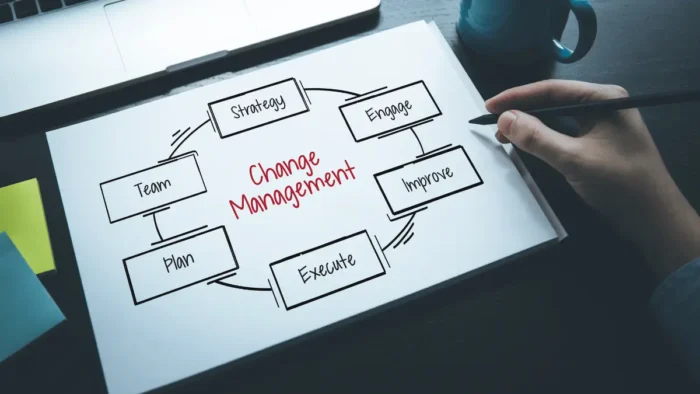
Managing resistance to change is essential to the success of all change efforts in each company. Dealing with resistance largely depends on your ability to recognize the real sources or causes of resistance to change.
Organizational change is an activity of transformation or modification of something in your organizational system. The primary purpose of this activity is to improve your business performance. You can’t find a person who would like to implement change if that change process brings results with which the organization will become worse or there will not be any improvements.
Why We Need Organizational Changes
An organization, business, or company is interacting with its environment. Each environmental change will affect the organization’s work and performance, and because of that, the organization will need to adapt to changes in the environment.
So, organizational change is the activity of differentiation or modification of the organization to bring improvements to overall business processes and adapt to the ongoing environmental changes.
On the other side, there will always be some sources of organizational changes.
Why Is There a Resistance to Change?
When we talk about organizational change, we need to mention that this process isn’t simply a journey from point A to point B. You will need to pass many barriers if you want to succeed in improving your business. One of the most significant barriers is resistance to change as an integral part of each change process.
Managers must know that there will always be persons in their organizations who will resist the proposed changes. Thus, the efficiency and effectiveness of the change process will be directly related to resistance to change and successfully to manage resistance to change.
How do People Respond to Organizational Change?
Managing resistance to change recognizes four types of persons regarding their responses to changes. So, we can have:
1. Persons who will initiate the change process.
Everyone wants to have such people in their company. Even though they know that the change process is not easy, they want to change the way how they work so the organization can stay competitive in the market. They always try new things and experiment with new things to change the current status quo situation.
You need to remember that these people are the ones who will initiate the change process. Your job as a manager will be to focus on helping them bring the change process to the table.
These people are leaders committed to making a change and will begin to act on their commitments. Commitment means they’ll take the necessary actions to turn their intentions into reality.
2. Persons who will accept the proposed change.
On the other side, you will have people who accept the proposed changes, no matter how they impact their own jobs. If the first group of people are leaders, then this group of people are followers. They follow change agents or change initiators and help them in their intentions to change the organization.
3. Persons who will be indifferent to the proposed change.
Also, many organizational members will be indifferent to the proposed changes. I don’t know how to define these people because they can accept or resist changes.
So, your job is to find these people and explain to them the benefits of the change process, their role in the process itself, and what they will get after the implementation.
4. Persons who will not accept the proposed change.
In the end, you will always have people who will not accept the proposed changes, no matter how they impact their future. Many people will be unsure about the process and its outcomes. Also, they can not see anything good for them as an outcome. They will become resistant to proposed changes.
You will need to identify these people and talk with them to explain why there is a need for organizational change. You need to amortize their impact on the success of the change process.
Those who do not belong to any of the above-mentioned categories are more likely to resist proposed changes and simultaneously accept or initiate other types of changes.
28 Causes of Resistance to Change
I have conducted a literature review and practical research to discover 28 possible causes of resistance to change. Here, I will shortly present these 28 causes of resistance to change:
1. The threat of power on an individual level.
It is more likely that managers will resist changes that will decrease their power and transfer it to their subordinates. In such a way, the threat of power is one of the causes of resistance to change.
2. The threat of power on an organizational level.
With the change process, some groups, departments, or sectors of the organization become more powerful. Because of that, some people will resist such a proposal or process if they lose their organizational power.
3. Losing control of employees.
The change process can sometimes reduce the level of control that managers can conduct. In such a way, managers or employees can resist the proposed changes if the change process will require a reduction of their control power;
4. Increasing the control of the employees.
Organizational changes can increase the managerial control of the employees, and this process can cause employees to become resistant to such proposals of change.
5. Economic factors.
Organizational changes can sometimes be seen from the employee’s side simply as something that will decrease or increase their salary or other economic privileges that some workplaces bring them before implementing the change process. It is normal to expect those who feel they will lose a portion of their salary to resist the change process.
6. Image, prestige, and reputation.
Each workplace has an adequate image, prestige, and reputation that are important to all employees. Organizational changes can make a drastic shift in these employees’ benefits. The proposed change will produce dissatisfaction if this is the case. So, image, prestige, and reputation are some of the causes of resistance to change.
7. The threat of comfort.
In many cases, organizational changes result in personal discomfort and make an employee’s life more difficult. They need to transfer from the comfort of the status quo to the discomfort of the new situation. Employees have the skills to do an old job without some special attention to accomplishing the task. Each new task requires forgetting the old methods of doing the job and learning new things that lead to a waste of energy and cause dissatisfaction.
8. Job security.
Organizational change can eliminate some workplaces and produce technological excess, layoffs, etc. Job security is simply one of the causes of resistance to change.
9. Reallocation of resources.
With organizational changes, some groups, departments, or sectors of the organization can receive more resources while others will lose them. This will bring resistance from individuals, groups, or departments that will lose some of their currently available resources.
10. Already gained the interests of some organized groups in the company.
Organizational change can make new groups more significant for the organization’s success. That’s a substantial threat to old coalitions that will cause resistance to change in those groups that will become more insignificant with the proposals.
11. Implications on personal plans.
Organizational change can stop other plans, projects, or personal or family activities. In such a way, this becomes one of the causes of resistance to change for those whom this change will reach.
12. Too much dependence on others.
In an organization, employees depend too much on other individuals. This dependence is based on the support they receive from influential individuals. If the change process brings the threat of that dependence, it will cause resistance to change in those people that this change will threaten.
13. Misunderstanding the process.
Organizational individuals usually resist change when they do not understand the real purpose of the proposed changes. When employees don’t understand the process, they typically assume something terrible. This will cause resistance to change.
14. Mistrust initiators for change.
When employees don’t trust the initiators of the process, they will not accept the process, which will cause resistance to change.
15. Different evaluations and perceptions.
Different evaluations and perceptions can affect organizational changes if people consider the proposed changes as a bad idea. Because of that, they are resistant to proposed changes.
16. Fear of the unknown.
In many cases, organizational change leads to uncertainty and a dose of fear. It is usual for people to feel fear of uncertainty. Employees feel uncertain about the transformation process and think changes are dangerous. This uncertainty causes organizational members to resist the proposed change.
17. Organizational members’ habits.
Employees’ work is based on habits, and work tasks are performed in a certain way based on those habits. Organizational changes require shifts in those habits, and there is dissatisfaction with these proposals.
18. Previous Experience.
All employees already have some experience with a previous organizational change process. So, they know that this process is not easy. That experience will tell them that most of the change processes in the past were failures. So this can cause resistance to change;
19. The threat to interpersonal relations.
Employees are often friends with each other and have strong social and interpersonal relationships inside and outside the organization. If an organizational change process can be seen as a threat to these powerful social networks in the organization, the affected employees will resist that change.
20. The weakness of the proposed changes.
Sometimes, the proposed change might have weaknesses that the employees can recognize. So, those employees will resist implementing the process until these weaknesses are not removed or solved.
21. Limited resources.
A normal problem in every organization is limited resources. When resources are limited, and the proposed organizational changes threaten those resources, resistance to change is more likely to occur.
22. Bureaucratic inertia.
Every organization has its own mechanisms, such as rules, policies, and procedures. Sometimes, when individuals want to change their behavior, these mechanisms, in many cases, can resist the proposed changes.
23. Selective information processing.
Individuals usually have selective information processing or only hear what they want to hear. They simply ignore information that is opposite to the current situation; with this, they don’t want to accept essential aspects of the proposed changes. Because of that, they become resistant to change.
24. Uninformed employees.
Often, employees are not provided with adequate information about organizational changes they must implement. Usually, this can cause resistance to change.
25. Peer pressure.
We can often have informal punishment for employees who support change by other employees who don’t support the same change. This situation can have a significant impact on increasing the level of resistance to change.
26. Skepticism about the need for change.
If the problem is not personal to employees, they will not see the real need to change themselves. Those who can’t see the need for change will have a low readiness level for the change process.
27. Increasing workload.
In organizational change, employees usually will implement activities of the new change process in addition to normal working activities. These increases in workloads affect the appearance of resistance to change.
28. There is always a short time to perform the change process.
Because organizational systems are open systems that interact with their environment, the need for change often comes from outside. In such a way, performance time is dictated outside of an organization. These situations lead to a short time for implementing the organizational change process and cause resistance to change.
Frequently Asked Questions
Organizational change is the activity of differentiation or modification of the organization to improve overall business processes and adapt to ongoing environmental changes.
There can be four types of people regarding their response to change: those who will initiate the change process, those who will accept the proposed change, those who will be indifferent to the proposed change, and those who will not accept the proposed change.
Resistance to change is a term that describes why some employees choose not to accept or adapt to the change process inside the organization.
According to the research of hundreds of literature sources, we interviewed 80 managers on all managerial levels to develop a list of 28 causes of resistance to change.
If you want more articles about organizational changes, try the following articles:
Reference List
The reference list of literature sources for these factors can be found here: 28 Factors That Causes Resistance to Change: Reference List.